Dust characterization of halos -- The extended emission in protoplanetary disks

Dust characterization of halos -- The extended emission in protoplanetary disks
Sreejita Das, Enrique Macías, Nicolas T. Kurtovic, Til Birnstiel, Elena M. Viscardi, Pietro Curone
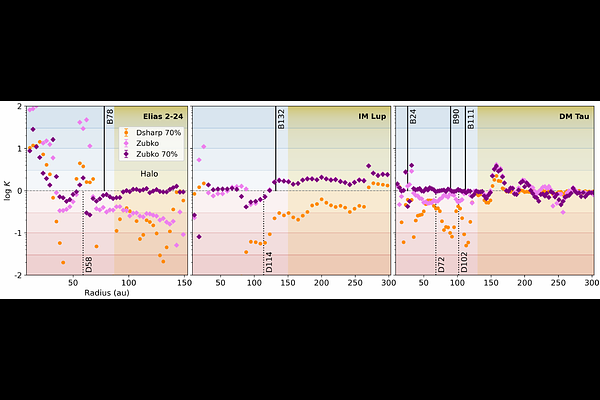
AbstractExtended, low surface brightness emission has been identified in a number of protoplanetary disks, in tension with predictions of radial drift theory. We aim to investigate the nature and origin of faint, extended dust emission in the outer regions of protoplanetary disks, which we define as the Halo, using multiwavelength (sub-)millimeter continuum observations of three systems: Elias 2-24, IM Lup, and DM Tau. We utilize Atacama Large Millimeter Array (ALMA) observations of our targets to perform spectral energy distribution (SED) fitting with four dust compositions and, derive radial profiles of their dust properties. The halos identified in our sources account for 20 - 30% of the total flux density at (sub-)millimeter wavelengths. In Elias 2-24, IM Lup, and DM Tau, we infer maximum grain sizes of 2 cm, $<$ 4 mm, and $<$ 9 mm, with the data best reproduced by porous amorphous carbon, compact amorphous carbon, and compact organic carbon compositions respectively. Their total dust masses are $125^{+34}_{-23}$, $301^{+139}_{-101}$, and $829^{+761}_{-378}$ M$_{\oplus}$, with corresponding halo masses of $33^{+12}_{-6}$, $103^{+25}_{-17}$, and $316^{+202}_{-117}$ M$_{\oplus}$. The halos of IM Lup and DM Tau are dust rich with gas-to-dust mass ratios of 64 and 18 respectively. In all three disks, the dust drift and growth timescales are shorter than the disk ages, implying that the smooth outer disks should not exist. The halos in our sources hold relevant fractions of the total dust reservoir, demonstrating that they play an important role in alleviating the mass-budget problem. While the persistence of halos in IM Lup and DM Tau could be explained by late infall, the presence of cm-sized grains in Elias 2-24's halo suggests that hidden pressure traps also play a role.