The dynamics of nucleolus-centromeres interaction in living cells

The dynamics of nucleolus-centromeres interaction in living cells
Yeo, W.-H.; Freeman, E.; Willis, A. B.; Zhang, H. F.; Foltz, D. R.; Huang, S.
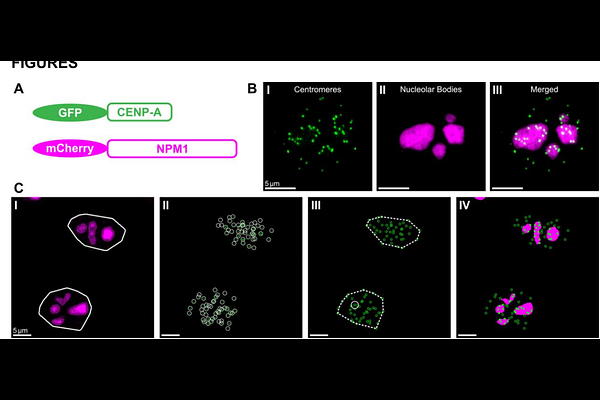
AbstractNucleoli and centromeres play essential roles in cellular proliferation and homeostasis, and are structurally and functionally interconnected. Centromeres frequently cluster around nucleoli, and some centromere assembly factors are known to reside in the nucleoli. To investigate the spatial and temporal relationships between these nuclear domains, we examined their dynamics in living cells. We imaged HeLa cells stably expressing mCherry-NPM1 and GFP-CENP-A using time-lapse microscopy. The results show that a subset of centromeres exhibits dynamic behavior during interphase, migrating over micrometer-scale distances within two hours. On average, 40-50% of centromeres maintain an association with nucleoli throughout interphase, with some cells displaying nucleolar-centromere association and dissociation within hours. Upon entry into mitosis, nucleoli are disassembled, and NPM1 localizes to the periphery of mitotic chromosomes. Nucleolar-centromere interactions are re-established in early G1, coinciding with the assembly of new centromeres. Treatment with actinomycin D, an inhibitor of RNA polymerase I, significantly reduces nucleolar size, nucleolar-centromere interactions, and centromere dynamics. Furthermore, post-mitotic nucleolar reformation is impaired. These findings highlight the dynamic nature of centromeres in interphase nuclei and their interactions with nucleoli. This behavior is partially dependent on rDNA transcription and nucleolar integrity, underscoring the critical roles of nucleoli, centromeres, and their interaction in 4D genome organization.