Post-Newtonian inspiral waveform model for eccentric precessing binaries with higher-order modes and matter effects

Post-Newtonian inspiral waveform model for eccentric precessing binaries with higher-order modes and matter effects
Gonzalo Morras, Geraint Pratten, Patricia Schmidt, Alessandra Buonanno
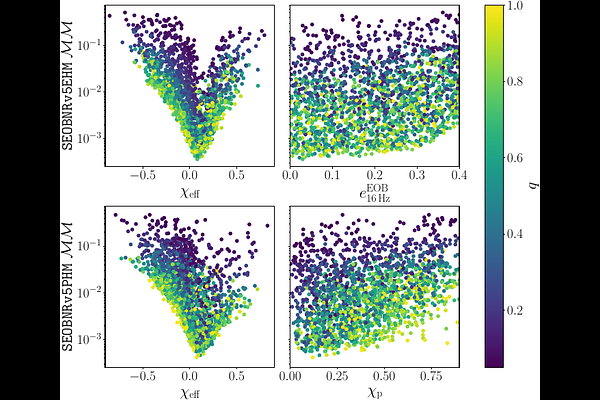
AbstractWe introduce pyEFPEHM, a post-Newtonian (PN) inspiral waveform model for eccentric and spin-precessing compact binaries that includes higher-order modes and matter effects. Accurate and efficient waveform models capturing these effects are essential for probing compact-binary formation channels and exploiting current and future gravitational-wave (GW) observations. pyEFPEHM extends pyEFPE, significantly improving its physical content and accuracy. In particular, we show that above 2.5PN order the quasi-circular contributions to the orbital phasing dominate at each PN order, and incorporate all available higher-order quasi-circular PN corrections to the phasing, including adiabatic tidal effects. We generalize the multiple-scale analysis solution of the spin-precession equations, extending it to higher PN orders and including all available quasi-circular corrections. Finally, we add eccentric corrections up to 1PN order in the waveform amplitudes, including the GW multipoles $(l,|m|)=(2,2),(2,1),(2,0),(3,3),(3,2),(3,1),(3,0),(4,4),(4,2),(4,0)$. We validate pyEFPEHM against analytical waveform models and numerical relativity simulations, showing that it provides a robust and computationally efficient description of the inspiral, with good agreement across a broad region of parameter space and up to close to merger. The accuracy degrades in the late inspiral for systems with very unequal masses ($m_2/m_1 \lesssim 0.1$), significant spins aligned with the orbital angular momentum ($|χ_\mathrm{eff}| \gtrsim 0.5$), and high eccentricities ($e \gtrsim 0.6$), where the PN expansion is expected to break down. pyEFPEHM represents a significant step toward physically complete and efficient waveform modeling of eccentric and precessing binaries, providing a foundation for future extensions including higher-order corrections, calibration to numerical relativity, and merger ringdown modeling.