Visceral Fat Metabolic Indices and Thyroid Function: A Stratified Analysis of Non-Linear Associations and Population Modifiers Using NHANES Data

Visceral Fat Metabolic Indices and Thyroid Function: A Stratified Analysis of Non-Linear Associations and Population Modifiers Using NHANES Data
Yang, Z. j.; Chen, K. j.; Pan, W.
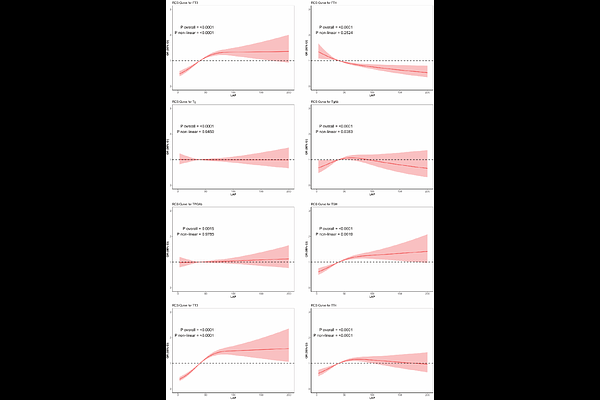
AbstractBackground: This study investigated the relationships between three visceral adiposity indices--visceral fat metabolic score (METS-VF), lipid accumulation product (LAP), and visceral adiposity index (VAI)--and thyroid function using NHANES 2007-2012 data. Methods: Adults with complete data on visceral adiposity indices and thyroid function were included. Multiple linear regression, restricted cubic spline (RCS) analyses, and subgroup analyses were performed to assess independent associations. Results: After full covariate adjustment, all three indices showed significant positive associations with FT3, FT3/FT4 ratio, TT3, and TT4. LAP and VAI were inversely associated with FT4, while VAI and METS-VF were positively associated with TSH. Quartile analyses confirmed dose-dependent relationships. RCS analyses revealed distinct non-linear patterns: LAP showed non-linearity with FT3, TSH, TT3, and TT4; VAI displayed reverse L-shaped curves for FT3, TSH, and TT3; METS-VF demonstrated non-linear increases for FT3 and TT3 with an inverted U-curve for FT4. Subgroup analyses identified age, sex, race, and smoking as significant effect modifiers, with stronger associations observed in younger or older adults, males, White participants, and high-income groups. Thyroid autoantibodies showed minimal associations across all indices. Conclusion: Visceral lipid accumulation is independently and non-linearly associated with thyroid dysfunction, modulated by demographic and lifestyle factors. These findings highlight the importance of visceral adiposity assessment in the early identification and intervention of obesity-related thyroid dysfunction.