Cell Type Architecture and Positional Gene Gradients in an Adult Animal at Subcellular Resolution

Cell Type Architecture and Positional Gene Gradients in an Adult Animal at Subcellular Resolution
Sun, M.; Wang, Y.; Han, K.; Guo, L.; Chen, Y.; Li, Y.; Lin, Y.; Liu, X.; Huang, Z.; Liu, Q.; Guo, W.; Zhang, R.; Zhao, W.; Liang, L.; Wei, X.; Zhou, L.; Mao, X.; Wang, J.; Wu, W.; Pan, H.; Yang, T.; Zhang, H.; Su, X.; Liu, S.; Zhang, W.; Liu, L.; Christensen, S. T.; Fei, J.; Liu, X.; Gu, Y.; Wang, J.; Yang, H.; Pei, G.; Fan, G.; Xu, X.; Li, H.; Xu, M.; Zeng, A.
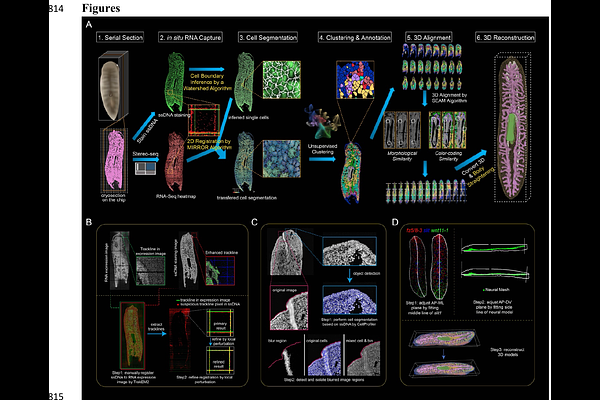
AbstractThe spatial organization of cell types and gene expression underlies tissue architecture and organismal physiology. However, resolving complete cellular and molecular landscapes within a three-dimensional context remains challenging, particularly in organisms with high cellular heterogeneity and complex geometry. Here, we developed a semi-supervised workflow to reconstruct high-resolution three-dimensional spatial transcriptomic models of the planarian Schmidtea mediterranea at single-cell resolution. Planarians are basal bilaterians capable of regenerating body structures after injury. Our reconstruction maps the distribution of cell types and spatially patterned gene expression across the intact organism and identifies 119 candidate positional control genes (PCGs). These genes are expressed across muscle, neural, and epidermal populations. Functional perturbation of selected candidates, including pitx3, ptpn11, pi4ka, upf3b, and cul1, revealed roles in regeneration following injury. In addition, we identify intestinal cells as prominent components of the microenvironment surrounding adult tgs1 pluripotent stem cells (neoblasts). Together, these results demonstrate the utility of three-dimensional spatial transcriptomic reconstruction for mapping cellular architecture and positional gene regulation in complex adult organisms.