How leaky? A large parameter study of leaky dust traps to quantify the transport of pebbles and ice in protoplanetary discs

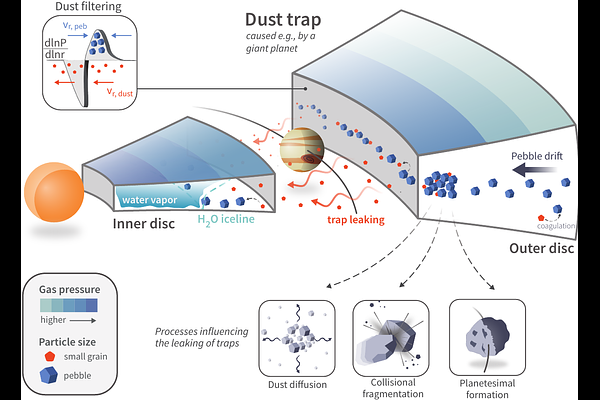
How leaky? A large parameter study of leaky dust traps to quantify the transport of pebbles and ice in protoplanetary discs
Adrien Houge, Anders Johansen, Andrea Banzatti, Sierra Grant
AbstractIn protoplanetary discs, the presence of dust traps can significantly alter the transport of solids from the outer to the inner regions, and hence they are often invoked as an explanation for the chemical diversity of inner discs observed with JWST (e.g., varying oxygen abundances and C/O ratios). As a detailed treatment of dust transport around dust traps is computationally expensive, earlier works investigating the impact of outer traps on the inner disc composition have often used simplified dust models representing the size distribution with a single effective size and drift speed. In this paper, we revisit the impact of outer traps on dust transport using the state-of-the-art one-dimensional dust evolution code \texttt{DustPy}, which simulates the transport and evolution of dust particles including detailed coagulation and fragmentation. We quantify and map the leakiness of dust traps across a broad parameter space, performing over 300 simulations while varying the disc viscosity, turbulence strength, planet mass and location, and dust fragmentation velocity. We find that dust traps are leakier than previously thought, on a broader parameter space, such that most outer traps (r > 5 au) will result in a long-lived O-rich inner disc with gas-phase C/O < 1. In similar conditions (e.g., carved by the same planet mass), we find inner traps are much leakier than outer traps, though their relative efficiency in reducing the pebble flux is time-dependent. Highly blocking traps altering the inner disc composition dramatically (leading, e.g., to C/O > 1) are possible to set up but necessitate low viscosity and weak turbulence, along with efficient planetesimal formation by the streaming instability. In that case, we find that is the formation of planetesimals, rather than the dust traps themselves, that is capable of significantly altering the inner disc composition.