Thermally inflated accretors in post-mass transfer binaries: Abell 35 and its class revisited

Thermally inflated accretors in post-mass transfer binaries: Abell 35 and its class revisited
Soumyadeep Bhattacharjee, Kareem El-Badry, Jim Fuller, Cheyanne Shariat, Natsuko Yamaguchi
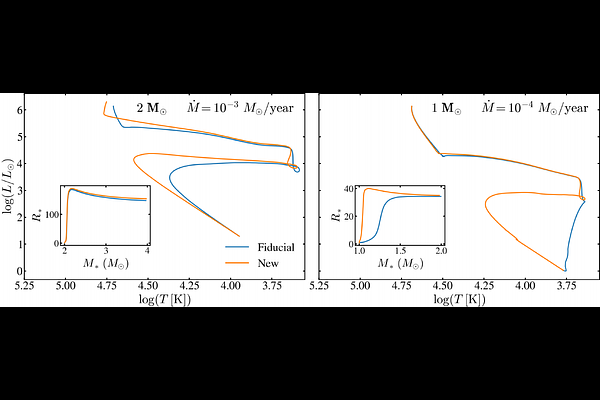
AbstractA small but growing class of binaries containing hot ($T_{\rm eff}\sim10^5\rm~K$) white dwarfs (WDs) and rapidly rotating, apparently subgiant companions -- including the prototype, Abell 35 -- show companions that are too large and luminous to be ordinary main-sequence stars yet too numerous to be explained as finely tuned near-twin binaries. We argue that these stars are instead main-sequence accretors temporarily inflated out of thermal equilibrium by recent mass transfer. For the subgiant of Abell 35, a new Gaia DR3 astrometric orbit ($P_{\rm orb} = 790$ d) combined with updated photometric and spectroscopic constraints yield $T_{\rm eff} \approx 4900~\rm K$, $R \approx 3~R_{\odot}$, near-solar metallicity, and rapid rotation aligned with the orbit ($v_{\rm rot} \approx 195~\rm km~s^{-1}$), indicating substantial recent accretion and spin-up. Dynamical mass limits disfavor a coeval twin-binary origin, supporting the inflated-accretor interpretation. We test this scenario using self-consistent MESA binary evolution calculations with a new accretion prescription in which accreted material retains a fraction of its infall energy. The accretor expands to giant-like radii when $\dot{M}$ is high yet remains within its Roche lobe, allowing stable mass transfer even for mass ratios traditionally considered unstable. After mass transfer ceases, the star contracts on Myr timescales through a bloated, rapidly rotating phase whose temperatures, radii, and spins match those observed in Abell 35-type systems. This framework explains the population without fine tuning and unifies Abell 35-type binaries with post-AGB binaries, blue lurkers, and wide WD$+$main-sequence systems as successive stages of the same post-mass-transfer evolutionary pathway.