Short-Range Forces Can Catalyze Extreme Orbital Evolution in Hierarchical Triples

Short-Range Forces Can Catalyze Extreme Orbital Evolution in Hierarchical Triples
Ygal Y. Klein, Chris Hamilton
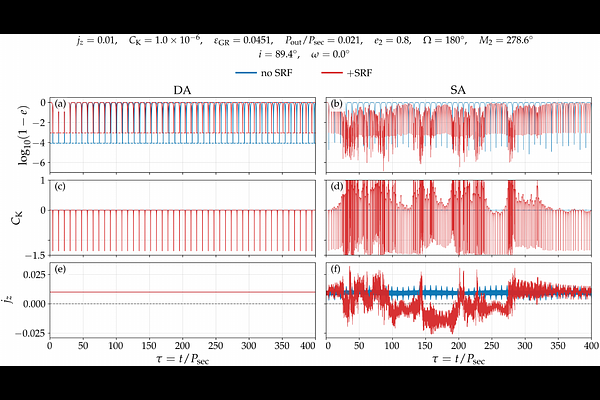
AbstractHierarchical triples are promising environments for producing exotica such as black hole mergers and hot Jupiters, because of the von Zeipel-Lidov-Kozai (ZLK) effect, whereby a distant tertiary can torque an inner binary to high eccentricity over secular timescales. In the double-averaged (DA) approximation to ZLK, this eccentricity excitation is suppressed by apsidal precession due to `short-range forces' (SRFs) like relativity and tidal/rotational bulges. Here we show that, when the DA approximation is relaxed, SRFs often catalyze, rather than suppress, extreme eccentricity behavior. This occurs because SRFs can drive large, discrete jumps in the binary's effective `adiabatic invariants' during high-eccentricity episodes. These nonadiabatic jumps can dramatically alter the maximum/minimum eccentricity and secular period of astrophysically relevant triples, including some for which SRFs were previously thought irrelevant. Even the angular momentum component $j_z$ evolves secularly -- to our knowledge, this is the first time such evolution has been demonstrated from a quadrupole-order, three-body mechanism. In short, binaries may explore much more of phase space than is implied by any (semi-)analytic ZLK theory of which we are aware. We demonstrate this at the test-particle quadrupole level; in a companion paper we show how even more-extreme behavior occurs when the jumps are combined with octupolar ZLK evolution.