Universal functionalization of extracellular vesicles with nanobody adapters

Universal functionalization of extracellular vesicles with nanobody adapters
Galisova, A.; Zahradnik, J.; Merunkova, E.; Havlicek, D.; Uskoba, J.; Porat, Z.; Jirak, D.
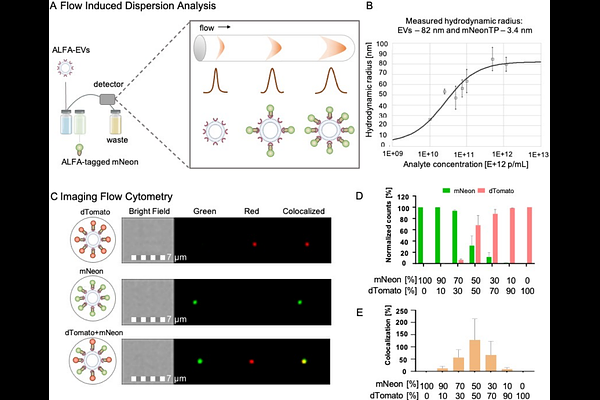
AbstractExtracellular vesicles (EVs) have emerged as a powerful platform for targeted therapies due to their intrinsic capacity for intercellular communication and low immunogenicity. In addition to their desirable natural properties, EVs can be engineered to programmably display targeting moieties on their surface, leading to enhanced specificity. Current methods for EV engineering rely on genetic engineering of parental cells, which is robust but labor-intensive due to the requirement to generate stable cell lines for each targeting protein. To address this hurdle, we introduce the Nanobody-Tag-Ligand system (NaTaLi), in which anti-ALFA tag nanobodies are anchored to the EV surface, enabling flexible and nearly covalent attachment of ALFA-tagged proteins. Crucially, NaTaLi allows stable and uniform functionalization of isolated EVs with any tagged protein, removing the need for further mammalian cell engineering. We demonstrate that NaTaLi enables simultaneous display of multiple functional moieties, allowing for precise tunability. In a murine model of breast cancer, NaTaLi-engineered EVs exhibited specific, high-efficiency delivery to tumor cells in vivo. Thus, NaTaLi is a versatile, plug-and-play system that may accelerate the development of targeted EV therapeutics and open the door to readily engineering complex, multispecific EVs.