Hints of enhanced magnetic activity after the intermediate rotation period gap as traced by the chromospheric Ca ii infrared triplet

Hints of enhanced magnetic activity after the intermediate rotation period gap as traced by the chromospheric Ca ii infrared triplet
Diego Godoy-Rivera, Savita Mathur, Tyler Richey-Yowell, Angela R. G. Santos, Rafael A. Garcia, Desmond H. Grossmann, Zachary R. Claytor, Paul G. Beck
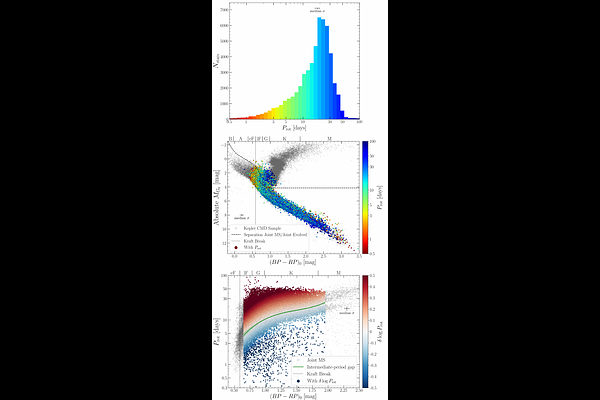
AbstractFor low-mass stars (M < 1.4 Msun), the connection between stellar rotation and magnetic activity governs stellar spin-down, shapes the environments of their exoplanets, and provides an age-diagnostic via magneto-gyro-chronology. Recently, unexpected phenomena known as the intermediate rotation period gap and the rotational stalling have been discovered. These are likely due to internal angular momentum redistribution, and mark departures from a smooth spin-down evolution. These features have been shown to cause enhanced magnetic activity on the photosphere, as measured by the photometric index from light curves (Sph), in both cluster and field stars. However, their influence on other magnetic activity proxies, and particularly in field stars, remains poorly understood. In this work, we study the impact of the intermediate-period gap on chromospheric magnetic activity as traced by the Ca ii infrared triplet (IRT) index. We target the stars observed by the Kepler mission, as this is the largest and most reliable sample of field stars with measured rotation periods sensitive to the gap. We calculate the Ca ii IRT index for the Kepler stars using the spectroscopic information from the Gaia mission data release three (DR3). We study the rotation-activity relation as a function of spectral type, finding that K dwarfs are more active than G dwarfs, which in turn are more active than F dwarfs. For main-sequence stars, we find that chromospheric magnetic activity is also enhanced after the intermediate-period gap, mirroring its effect on the photospheric Sph index. Our work reveals that the intermediate-period gap marks a genuine transition in stellar magnetic behavior, not only at the photosphere but also at the chromosphere. This highlights the need to account for its signatures across activity proxies, as well as its impact on exoplanet habitability and the age-rotation-activity relation.