Glial ceramide orchestrates Lipid Droplet homeostasis and age-dependent motor function in Drosophila

Glial ceramide orchestrates Lipid Droplet homeostasis and age-dependent motor function in Drosophila
Garg, L.; H, K.; DEIVASIGAMANI, S.; Ratnaparkhi, A.; RATNAPARKHI, G. S.
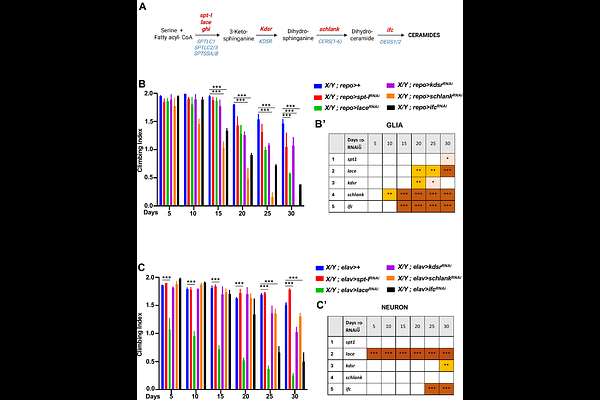
AbstractGlia cells have emerged as equal partners to neurons in the development and maintenance of the nervous system. In this study, we examine the roles of ceramide metabolism and intracellular transfer in glia, contrasting these with those of neurons. We find that glia are more sensitive to the cessation of ceramide synthesis than neurons. Knockdown of ER-localised ceramide synthesis enzymes in glia, but not in neurons, leads to age-dependent motor defects. Intriguingly, Lipid Droplet (LD) size and density are lowered when either glial ceramide is reduced or its transfer to the Golgi, by Ceramide Transfer protein (CERT), is disturbed. Glial CERT knockdown or disruption of its interaction with the ER tethering protein VAPB also affects both motor function and LD dynamics, highlighting the importance of targeted, efficient non-vesicular ceramide transfer at membrane contact sites. Our research implicates reduced flux through the sphingolipid pathway in glial cells as a critical determinant of adult motor function, with LDs serving as a sensitive diagnostic readout. As such, our study has implications for a host of human motor neuron diseases that show late-onset motor deficits.