Spider-Webb: Spatially-Resolved Evidence of Inside-Out Quenching in the Spiderweb Protocluster at $z \sim 2$

Spider-Webb: Spatially-Resolved Evidence of Inside-Out Quenching in the Spiderweb Protocluster at $z \sim 2$
Ronaldo Laishram, Yusei Koyama, Abdurrahman Naufal, Tadayuki Kodama, Rhythm Shimakawa, Kazuki Daikuhara, Helmut Dannerbauer, Jose Manuel Pérez-Martínez, Pablo G. Pérez-González
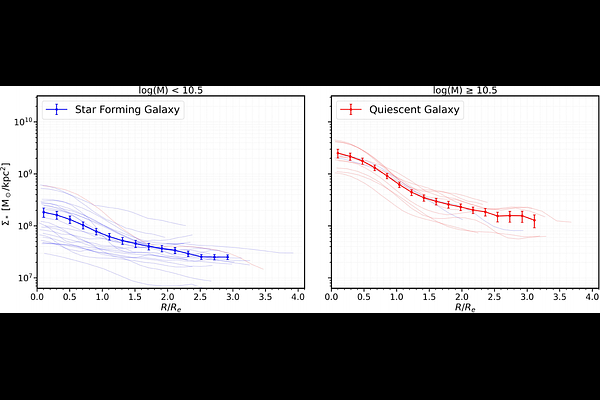
AbstractWe present a spatially-resolved analysis of galaxy quenching within the Spiderweb Protocluster at $z \sim 2.16$, combining deep imaging from the James Webb Space Telescope (JWST) and the Hubble Space Telescope (HST). Utilizing pixel-by-pixel spectral energy distribution fitting, we derive maps of stellar mass, star formation rate (SFR), specific SFR (sSFR), and rest-frame UVJ colors. Quiescent galaxies, predominantly found at $\log(M_*/M_{\odot}) \geq 10.5$, exhibit clear mass-dependent inside-out quenching, with central sSFR approximately an order of magnitude lower than outer regions, while lower-mass star-forming galaxies show flat sSFR profiles. Central star formation activity fundamentally anti-correlates with Sérsic index, indicating reduced activity in bulge-dominated systems. Spatially resolved UVJ colors reveal heterogeneous internal star formation, distinguishing star-forming regions in quiescent hosts from those in globally star-forming systems. These findings demonstrate that quenching mechanisms were effectively operating by $z \sim 2$, with the observed inside-out patterns and morphological correlations consistent with AGN-driven feedback processes. Our study provides key observational constraints on galaxy evolution during this critical epoch.