Expansion Microscopy reveals changes in cellular and extracellular structures between healthy and perturbed tendons

Expansion Microscopy reveals changes in cellular and extracellular structures between healthy and perturbed tendons
Woodworth, M.; McDonnell, T.; Xiang, J.; Li, Z.; Heo, Y.; Evans, M. K.; Mauck, R.; Heo, S.-J.; Dyment, N.; Lakadamyali, M.
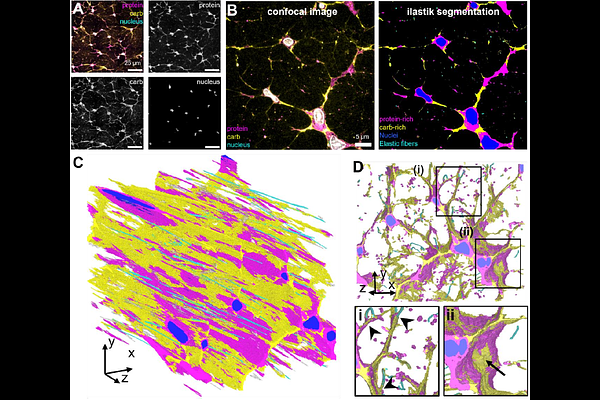
AbstractTendons transmit mechanical forces between muscles and bones through their highly aligned, collagen-rich extracellular matrix. When damaged, resident cells help restore this matrix. However, in tendinopathies, this repair response fails, leading to loss of proper tendon function. How altered mechanical states reshape tendon cell and matrix architecture remains poorly understood because existing methods do not readily capture tendon structure across relevant length scales. Here, we combine Fluorescent Labeling of Abundant Reactive Entities (FLARE) with Expansion Microscopy (ExM) to visualize cellular and extracellular structures in native tendon tissue. FLARE-ExM resolves the dense fibrillar matrix across multiple tendon types, including elastic fibers and glycan-rich cellular protrusions. In a tendon resection model, acute loss-of-tension was associated with increased fibril width and expansion of carbohydrate- and protein-rich regions. In ruptured human Achilles tendon, FLARE-ExM revealed extracellular disorganization and disrupted cellular architecture. These results establish FLARE-ExM as a useful approach for studying how mechanical perturbation remodels tendon architecture across physiological and disease contexts.