Disrupted Emotional Neural Synchrony in Schizophrenia Revealed by Intersubject Correlation of Naturalistic fMRI

Disrupted Emotional Neural Synchrony in Schizophrenia Revealed by Intersubject Correlation of Naturalistic fMRI
Pallavicini, C.; Costanzo, E. Y.; de la Fuente, L. A.; Castro, M. N.; Guinjoan, S. M.; Tagliazucchi, E.; Villarreal, M.
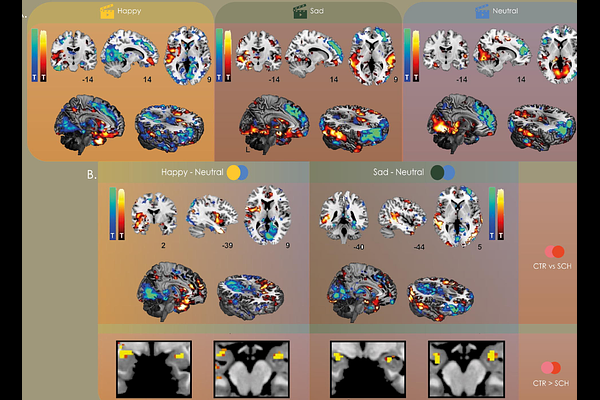
AbstractBackground: Schizophrenia is marked by impairments in emotional processing and social cognition, yet traditional neuroimaging paradigms often lack the ecological validity to capture these deficits in real-world contexts. Methods: In this study, we used intersubject correlation (ISC) analysis of functional MRI data to examine shared neural representations of naturalistic visual narratives in individuals with schizophrenia and healthy controls. Participants viewed short films designed to evoke happy, sad, and emotionally neutral responses, allowing us to compare how synchronized brain activity varied with emotional content across and within groups. Results: Healthy controls showed greater ISC in regions associated with affective salience, emotion recognition, and social understanding, including the amygdala, insula, and temporal cortices. In contrast, participants with schizophrenia displayed higher synchrony in visual, subcortical, and frontal areas, suggesting a reliance on perceptual and executive systems. To isolate the effects of emotion from general visual processing, we compared ISC during emotional clips relative to neutral videos. This revealed significantly reduced synchrony in the bilateral amygdala in patients, highlighting a core dysfunction in affective engagement. Interestingly, neutral stimuli elicited unexpectedly strong synchronization in frontal and limbic regions in the schizophrenia group, possibly reflecting altered salience attribution to ambiguous or emotionally ambiguous content. Conclusions: These results point to a functional reorganization of affective processing in schizophrenia, where impaired limbic recruitment is accompanied by compensatory engagement of perceptual and cognitive control networks. ISC during naturalistic stimulation emerges as a powerful tool for capturing subtle disruptions in shared emotional experience in psychiatric populations.