Cycle-by-cycle respiration waveforms are coupled with the shape of neural oscillations

Cycle-by-cycle respiration waveforms are coupled with the shape of neural oscillations
Kosik-Rose, E. L.; Zhou, G.; Sherif, A.; Rosenow, J. M.; Schuele, S. U.; Oluigbo, C. O.; Teti, S. A.; Koubeissi, M.; Mowla, M. R.; Rhone, A. E.; Kumar, S.; Dlouhy, B. J.; Zelano, C.; Voytek, B.
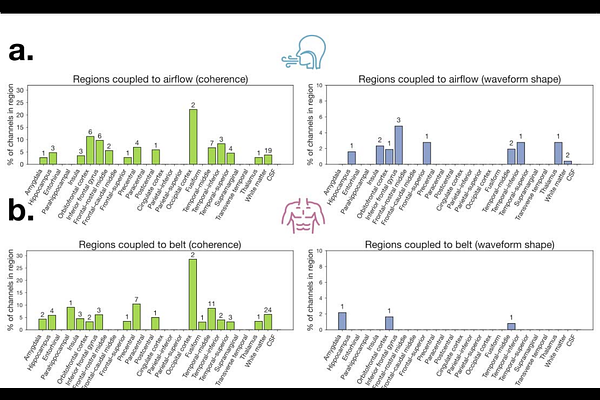
AbstractBeyond sustaining life, breathing is a vital physiological rhythm that shapes cognition, perception, emotional regulation, and mental health. Breathing has a direct effect on neuronal excitability and is coupled to neural oscillations across a variety of brain regions. Notably, both respiration and neural oscillations are asymmetric and not perfectly rhythmic: for example, every breath has a different shape and duration, and is interspersed with variable pauses. Here, we examined the coupling between breathing and the brain by quantifying the nonsinusoidal features of each breath and comparing it to the shape of each corresponding neural oscillation cycle. By leveraging invasive human brain recordings from 16 participants, we found respiration-neural waveform coupling on a breath-by-breath, cycle-by-cycle basis across limbic and cortical forebrain regions. For decades, the dominant perspective on cognition and mental health have focused on the brain, but recent work is highlighting the importance of brain-body interactions. Our results show that the coupling between breathing and neural activity is much richer than previously appreciated, and our approach opens new avenues for studying these peripheral-to-central nervous system interactions in a more robust, temporally precise manner.