ATOMIUM: Inner circumstellar envelopes of oxygen-rich AGB stars as revealed by highly excited SiO lines

ATOMIUM: Inner circumstellar envelopes of oxygen-rich AGB stars as revealed by highly excited SiO lines
B. Pimpanuwat, S. Etoka, M. D. Gray, A. M. S. Richards, A. Baudry, F. Herpin, T. Danilovich, L. Decin, M. O. Lewis, I. El Mellah, C. A. Gottlieb, Y. Mori, H. S. P. Müller, R. Sahai, K. T. Wong, J. A. Yates, A. Zijlstra
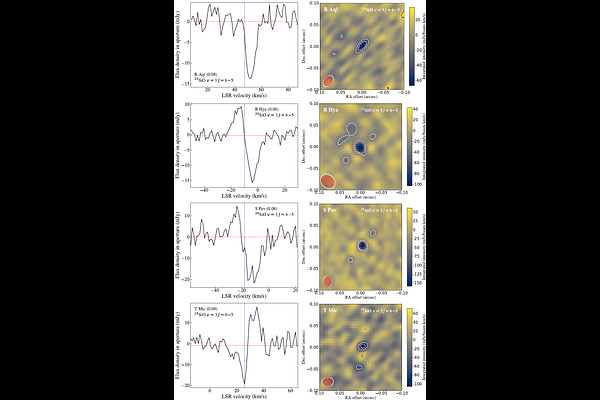
AbstractSilicon monoxide (SiO) traces the physical conditions and dynamics in the circumstellar envelopes (CSEs) of AGB stars. We present high-resolution ALMA Band 6 observations of highly excited SiO emission in 14 oxygen-rich AGB stars. We cover transitions from v = 0 to v = 8, including first detections of 28SiO v = 3, 4, 8, J = 6-5, 29SiO v = 6, J = 6-5, and 30SiO v = 4, 5, J = 6-5, some of which are masers. The v = 8 transition is the highest v-state observed in an AGB star yet. Masers in v = 0 are detected clearly in V PsA and IRC+10011 and tentatively in T Mic. R Hya exhibits the richest SiO spectrum. SiO J = 6-5 absorption is seen in R Aql, R Hya, S Pav, and T Mic, with features indicative of both infalls and outflows, and tentative detection of 28SiO v = 8, J = 6-5 absorption is found towards S Pav and R Aql. Highly excited SiO emission is often distributed in arcs or clumps with velocity gradients; components in R Hya and U Her align with predicted shock fronts. Detection rates show no significant difference between low and high mass-loss rate stars, although line overlap may affect some intensities. Maser detections appear uncorrelated with pulsation period or phase. The radius enclosing 90 per cent of compact SiO emission shows a tentative correlation with mass-loss rate. These results highlight the role of mass loss and CSE geometry in shaping high-excitation SiO emission.