RNase E resolves toxic condensates by counteracting phase separation of Type II RhlB helicases

RNase E resolves toxic condensates by counteracting phase separation of Type II RhlB helicases
Hausmann, S.; Geiser, J.; Vadas, O.; Guex-Crosier, S.; Gonzalez, D.; Valentini, M.
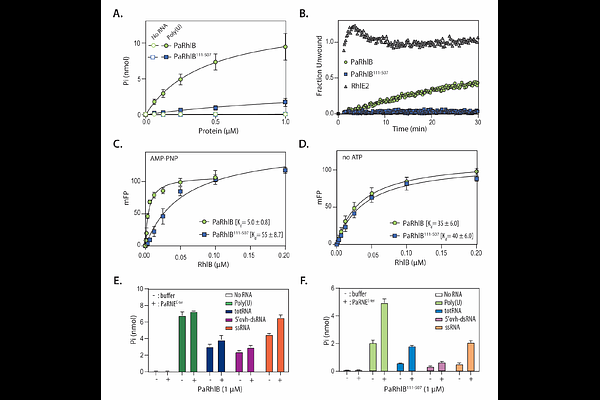
AbstractIn many Proteobacteria, the RNA helicase RhlB is a component of the RNA degradosome, a multi-protein complex involved in RNA processing and degradation. Within this complex, RhlB interacts with the scaffold endoribonuclease RNase E. In Escherichia coli, allosteric activation of RhlB by RNase E has defined the current paradigm for RhlB regulation. Here we identify a distinct clade of RhlB helicases, exemplified by Pseudomonas aeruginosa RhlB, which we designate Type II. Unlike Type I RhlB, Type II RhlB helicases contain an N-terminal intrinsically disordered region that drives RNA-dependent liquid-liquid phase separation and enhances RhlB activity. Biochemical, structural, and functional analyses show that P. aeruginosa RNase E binds RhlB through an interface distinct from that described in the E. coli model and, rather than stimulating activity, antagonizes RhlB phase separation. Excessive RhlB condensation impairs bacterial growth at low temperature, and RNase E-mediated control of RhlB condensation maintains growth under these conditions. Together, these findings reveal that conserved RNA degradosome components can engage in distinct regulatory interactions across species and identify condensate dissolution as a novel mechanism regulating RNA helicase activity.