Early life stress of maternal deprivation and peer-rearing jeopardize mesoprefrontal and mesolimbic dopamine receptors in the rhesus monkey

Early life stress of maternal deprivation and peer-rearing jeopardize mesoprefrontal and mesolimbic dopamine receptors in the rhesus monkey
Seraphin, S. B.; Sanchez, M. M.
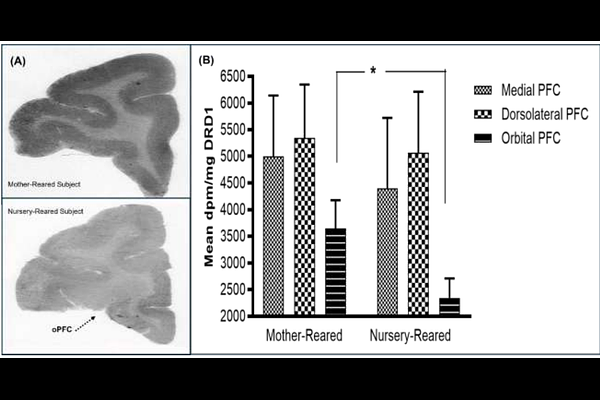
AbstractEarly life stress (ELS) in primates alters dopamine function, contributing to addiction, hyperactivity, cognitive deficits, aggression, and social subordinance. To assess whether dopamine receptor densities are affected by ELS, male juvenile rhesus monkeys (Macaca mulatta) were either mother-reared (MR, N=6) in a semi-natural environment or nursery-reared (NR, N=6) with peers in a laboratory. At 1.5 years of age, subjects were sacrificed and the left prefrontal cortex (PFC), striatum (caudate and putamen), nucleus accumbens (NAcc), and claustrum (CLA) were explored through quantitative autoradiographic studies of dopamine receptor-1 (DRD1) and -2 (DRD2) conducted using [125I]-(+)-SCH 23982 and 125I-Epidepride, which have high affinity and selectivity for DRD1 and DRD2, respectively. No group differences emerged in striatal or NAcc receptor binding. However, MR monkeys exhibited significantly greater DRD1 binding in the left orbital PFC and significantly greater DRD2 binding in both the left medial PFC and right CLA compared to NR. These findings implicate the medial PFC (stress vulnerability, cognition), orbital PFC (reward valuation), and CLA (anxiety modulation) as critical sites disrupted by maternal deprivation. Therefore, we propose that nursery-rearing induces a hypodopaminergic prefrontal-claustral ecophenotype, underlying the cognitive, affective, and social impairments observed in NR monkeys.