bZIP63 misregulation affects growth and target gene expression under short-day photoperiods

bZIP63 misregulation affects growth and target gene expression under short-day photoperiods
Campos, R. A.; Carlson, P. T.; Sebastiao, I.; Vieira, J. G. P.; Matiolli, C.; Viana, A. J. C.; Vincentz, M.
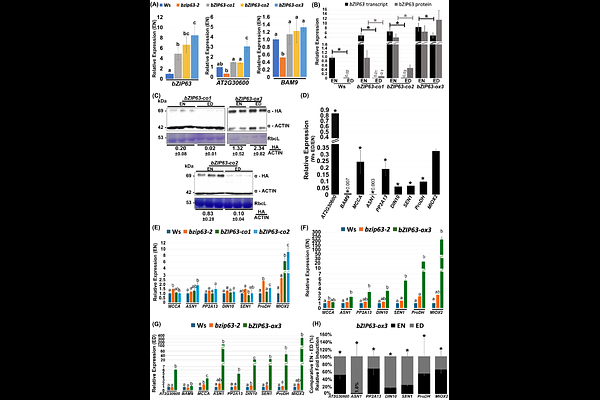
AbstractPlant survival and growth depend partly on the ability to manage energy resources in response to changing environmental conditions. SnRK1 plays a central role in this process by restricting growth under energy limiting conditions while promoting stress adaptation and survival. When activated, SnRK1 triggers transcriptional reprogramming that prioritizes energy-producing pathways. A key mediator of this response is the transcription factor bZIP63, whose activity is regulated by SnRK1 dependent phosphorylation. Given its roles in energy homeostasis and its interaction with the circadian clock, bZIP63 influences growth and is therefore a candidate component of the Metabolic Daylength Measurement (MDLM) system, which integrates starch and sucrose metabolism with circadian timing and photosynthetic duration to regulate vegetative growth under contrasting photoperiods. We show that 39 bZIP63 direct targets regulated by SnRK1 correspond to a subset of shortday induced genes associated with the MDLM system and are downregulated in a bZIP63 T-DNA mutant (bzip63-2) and/or in an RNAi induced silencing line (RNAiWs_L9). Downregulation of these genes was more extensive in RNAiWs_L9 than in bzip63-2, possibly due to the unexplained silencing of BAM4, a {beta}-amylase that promotes starch degradation. Under short day conditions, the frameshift mutant bzip63-5 (Col-0), bzip63-2 (Ws), and the bzip1-1/bzip53-1/bzip63-5 (Col-0) triple mutant, which disrupts bZIP63 heterodimerization partners, showed similar deregulation of a subset of these genes and comparable growth inhibition, whereas both growth and gene deregulation were more strongly affected in RNAiWs_L9. We further show in two partially complemented bzip63-2 lines that bZIP63 protein levels increase toward the end of the night and decline toward the end of the day, in synchrony with the diel oscillation of its transcript. Additional analyses of these lines, together with bzip63-2 line overexpressing bZIP63, suggest that the timing and amplitude of bZIP63 accumulation contribute to shaping the expression profiles of a subset of the 39 MDLM associated genes. Together, these findings indicate that bZIP63 participates in a regulatory network linking SnRK1 signaling, photoperiod-changes, and growth within the MDLM system.