Photometric Metallicities for 367,324 stars of Omega Centauri

Photometric Metallicities for 367,324 stars of Omega Centauri
Xue Lu, Haibo Yuan, Bowen Huang, Tao Wang, Timothy C. Beers
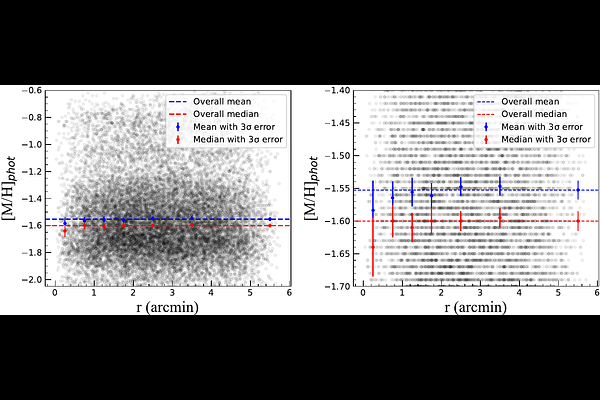
AbstractOmega Centauri is the most massive and chemically complex multi-population globular cluster with a wide metallicity range that has been extensively studied photometrically and spectroscopically. Using the wide metallicity range of omega Cen, HST photometry (F275W, F336W, F435W, F625W), and MUSE spectroscopy ([M/H]), we derive [M/H]- and M_{F625W}-dependent stellar loci to estimate photometric metallicities from HST colors. Our tests yield metallicity precisions of 0.10\,dex for giants and 0.22\,dex for fainter dwarfs. We construct a photometric metallicity catalog from simultaneous F336W, F435W, and F625W observations (plus F275W where available), containing 20,778 giants and 346,546 dwarfs. A subsample of 20,533 giants is used to study the spatial metallicity distribution and gradient. We find no significant metallicity gradient within the half-light radius, consistent with previous work. Moreover, the previously reported ring-like structure is less pronounced in our data, and no physically significant, irregular two-dimensional metallicity pattern is detected, indicating that the stellar subpopulations are well mixed within the half-light radius. Our catalog significantly extends the metallicity sample of omega Cen, and this approach can be applied to other HST data to estimate photometric metallicities.