Near-Infrared and Optical Observations of SN 2024rbc: The First Early Detection of CO and Dust in a Type Ib Supernova

Near-Infrared and Optical Observations of SN 2024rbc: The First Early Detection of CO and Dust in a Type Ib Supernova
Ryan Hwangbo, Jeonghee Rho, Aravind P. Ravi, Seong Hyun Park, Harim Jin, Sung-Chul Yoon, T. R. Geballe, Ryan Foley, Kirsty Taggart, Kyle W. Davis, Kishore C. Patra, S. Tinyanont, Jesper Sollerman, Steve Schulze, Natalie LeBaron, Chang Liu, Charles D. Kilpatrick
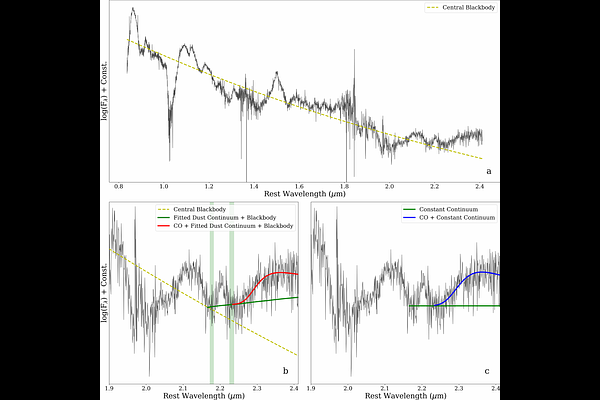
AbstractWe present optical and near-infrared (NIR) observations of the Type Ib supernova (SN) 2024rbc. Emission from the first CO overtone, resting on a dust continuum at $2.3-2.4$ $μ$m, was observed at 62 days post-explosion. The CO band heads are not seen; the emission is broad and devoid of sharp spectral structure. This is the first observation of CO in the ejecta of a Type Ib SN reported in literature. Fitting a LTE model to the CO overtone derives a mass of $(5.2 \pm 1.2)$ $\times$ 10$^{-4}$ $M_{\odot}$, a temperature of $4040 \pm 435$ K, and a velocity of $5905 \pm 1960$ km s$^{-1}$. We also fitted a modified blackbody model to the dust continuum, deriving a dust temperature of $910 \pm 10$ K and a mass of $(1.3 \pm 0.1)$ $\times$ $10^{-3}$ $M_{\odot}$. Furthermore, the spectra of SN 2024rbc exhibit strong He I lines and numerous neutral and ionized metal lines. Comparing the spectral evolution of SN 2024rbc to other Type Ib, Ic, and IIb SNe indicates it is a Type Ib SN. Additionally, fitting SN light curve models of helium star progenitors computed with the STELLA code to photometric observations indicates a $^{56}$Ni mass of $0.07$ $M_\odot$ and an ejecta mass of $1.7$ $M_\odot$. We also compare the velocities of key optical lines to examine the evolution of the ejecta. Lastly, we discuss the observed CO and dust emission and its implications for early-Universe dust formation.