Cambrian Artiopoda Reveals a Constraint in Euarthropod Brain Evolution

Cambrian Artiopoda Reveals a Constraint in Euarthropod Brain Evolution
Strausfeld, N. J.; Hou, X.; Hirth, F.
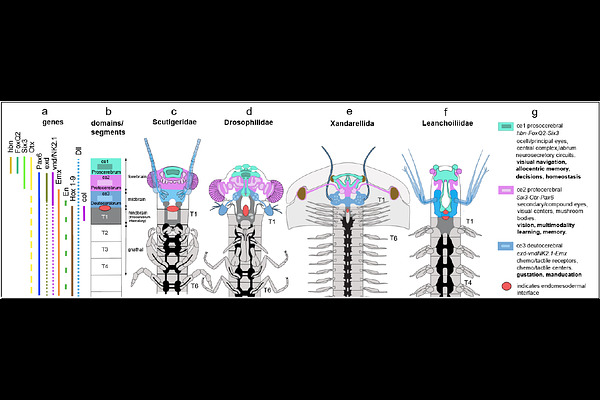
AbstractFossilized traces of neuropils, nerves and ganglia have demonstrated that cerebral organization in Cambrian arthropods conforms to a ground pattern defining one of two existing euarthropod clades, Mandibulata and Chelicerata. Artiopoda, a third clade including trilobites and soft-bodied relatives, persisted until the late Carboniferous, but its cerebral organization has remained unknown. Here we identify and reconstruct fossilized neural traces of the artiopodan Xandarella spectaculum, which reveal an expanded prosocerebrum associated with paired ocelli, a truncated protocerebrum supplied by substantial lateral eyes, and salient deutocerebral antennular lobes. This arrangement predicts reliance on chemosensory guided foraging, with visual processing largely limited to dorsal orientational cues and simple local motion signals. The artiopodan brain thus reveals clade-specific modifications of homologous domains of the euarthropod cerebral ground pattern established in the early Cambrian.