Fungal-beetle networks in deadwood are modular and shaped by tree species and deadwood type

Fungal-beetle networks in deadwood are modular and shaped by tree species and deadwood type
Faticov, M.; Dahlberg, A.; Hjalten, J.; Lofroth, T.; Hekkala, A.-M.
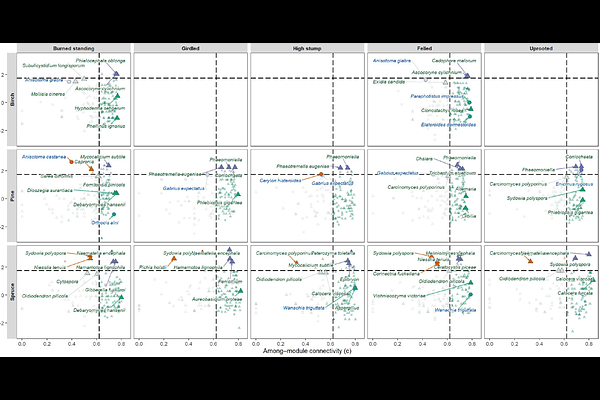
AbstractDeadwood is a key habitat for forest biodiversity, yet how tree species and deadwood type shape linked fungal-beetle communities remain poorly understood. We explored saproxylic fungi and beetles in a large-scale restoration experiment on birch, pine, and spruce deadwood created as burned standing trees, felled logs, girdled trees, high stumps, and uprooted trees. As expected, we found that tree species was the main driver of both fungal and beetle community composition, while deadwood type was the second most important driver. Fungal-beetle community correlations were context dependent: significant multivariate correlations were detected for pine and spruce, but not birch, and were strongest in burned standing pine, burned standing spruce, and girdled spruce. Across all tree species and deadwood types, fungal-beetle co-occurrence networks were consistently less nested and more modular than expected by chance, indicating structured, compartmentalized associations of fungi and beetles even within single deadwood units. These results show that maintaining diverse tree species and deadwood types is essential to retain specialized multitrophic communities and the ecological processes they support.