Coronavirus envelope protein drives iron sensing disorder by hijacking the TAp73-FDXR axis

Coronavirus envelope protein drives iron sensing disorder by hijacking the TAp73-FDXR axis
Zhu, M.; Hu, L.; Fu, X.; Yuan, B.; Guan, G.; Han, L.; Rong, Z.; Tian, R.; Li, G.; Du, M.; Ma, Y.; Xu, N.; Liu, H.; Tian, H.; Yin, X.; Zhong, J.; Sun, M.; Yang, S.; Liu, S.; Liu, Q.; Li, J.; Fan, B.; Chen, Y.; Zhao, Q.; Zhou, T.; Chang, L.; Zhao, X.; Ran, X.; Du, Q.; Ding, S.; Li, B.; Huang, Y.; Tong, D.
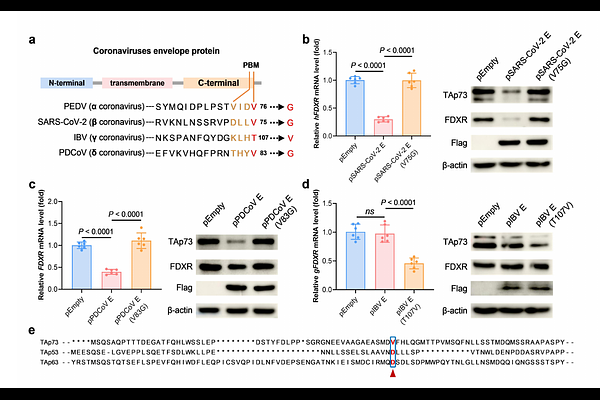
AbstractIron overload is increasingly recognized as a critical contributor to coronavirus pathogenesis, yet the underlying induction mechanisms remain unclear. Here, we uncover a fundamental pathway by which coronavirus drives IRP1 RNA-binding activity to induce iron accumulation via targeting the TAp73-FDXR axis. Specifically, coronavirus infection represses transcription of FDXR (encoding the key rate-limiting enzyme in host iron-sulfur cluster synthesis), thereby impairing host iron-sulfur cluster generation to trigger the functional conversion of the cytosolic aconitase 1 (ACO1) into iron-regulatory protein 1 (IRP1), ultimately leading to the host's persistently false perception of iron deficiency. We identify TAp73 as the primary transcription factor governing FDXR expression, and demonstrate that the coronavirus envelope protein (CoV-E) orchestrates TAp73 nuclear export. Subsequently, CoV-E binds TAp73 through a critical valine residue within its C-terminal PBM domain, inducing the K48-linked ubiquitination and proteasomal degradation of TAp73. Furthermore, we developed a CoV-E-targeting molecule, DPTP-FC, which blocks CoV-E-TAp73 interaction via forming steric hindrance and effectively alleviates iron accumulation and tissue damage caused by PEDV, PDCoV, and SARS-CoV-2 infection. Our study reveals the central role of the TAp73-FDXR axis in CoV-induced iron accumulation, highlighting CoV-E as an attractive antiviral target and DPTP-FC as a promising therapeutic candidate.