Temperature-resolved sensitivities of $^{56}{\rm Ni}$ production to helium-burning reactions in pair-instability supernovae

Temperature-resolved sensitivities of $^{56}{\rm Ni}$ production to helium-burning reactions in pair-instability supernovae
Hiroki Kawashimo, Nobuya Nishimura, Yudai Suwa
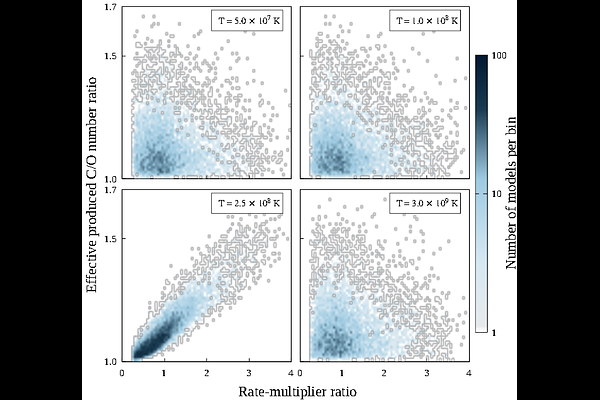
AbstractWe propose a temperature-resolved Monte Carlo (MC) approach to identify the temperature regimes in which low-energy helium-burning reaction rates most strongly affect nucleosynthesis in very massive stars that undergo pair-instability supernovae (PISNe). By performing MC simulations of PISNe, we quantify how temperature-dependent variations in key helium-burning reaction rates, i.e., the triple-$α$ and $^{12}{\rm C}(α,γ)^{16}{\rm O}$ rates, influence $^{56}{\rm Ni}$ synthesis. Thousands of stellar evolution calculations using $\texttt{MESA}$ reveal that both the $^{12}{\rm C}(α,γ)^{16}{\rm O}$ and triple-$α$ reactions exhibit their strongest sensitivity at $T \simeq 2.5 \times 10^{8}\,{\rm K}$, but with opposite correlation signs. We show that this temperature corresponds to the regime in which the ratio of the sampled rate multipliers is most clearly imprinted on the pre-carbon-burning C/O composition. This demonstrates that PISN nucleosynthesis can probe helium-burning reaction rates in specific low-temperature regimes.