Two hot pre-white dwarfs inside the red-giant-branch planetary nebula Pa 13 -- Double core evolution or common envelope-induced rejuvenation?

Two hot pre-white dwarfs inside the red-giant-branch planetary nebula Pa 13 -- Double core evolution or common envelope-induced rejuvenation?
Nicole Reindl, David Jones, Todd Hillwig, Marcelo M. Miller Bertolami, Matti Dorsch, Nicholas Chornay, Max Pritzkuleit
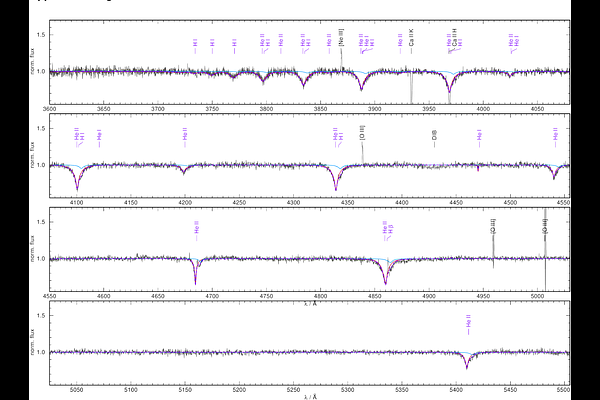
AbstractClose binary central stars of PNe offer a unique window for investigating the conditions immediately following the ejection of a common envelope (CE). Double eclipsing and double-lined double systems are particularly valuable as they provide minimally model-dependent constraints on fundamental binary parameters. We report that the nucleus of Pa13 (P=0.3988d) belongs to this rare class of systems and present a comprehensive analysis of its double-degenerate binary. We performed a two-component NLTE spectral analysis based on phase-resolved X-Shooter spectroscopy, multi-band light-curve modeling, SED fitting, as well as a kinematic analysis. Both stars are found to be hot pre-white dwarfs, with Star1 being cooler but larger (Teff=50kK, R=0.40Rsol) than Star2 (Teff=75kK, R=0.16Rsol). The weakness of spectral lines of Star2 made both the atmospheric and RV analyses challenging, and we uncovered a strong sensitivity of the assumed surface ratio to its derived RV curve. Yet, the RV curve and Kiel mass of Star1 (M1=0.41+/-0.02Msol) could be determined precisely, allowing for a dynamical mass determination of Star2 (M2=0.39+/-0.04Msol). We uncovered that Pa13 exhibits a small but significant orbital eccentricity (e=0.02+/-0.01), making it only the second post-CE binary nucleus with a measured eccentricity. We conclude that Pa13 provides hitherto the strongest evidence that PNe can be observed around post-RGB stars. Immediately after the CE-ejection, Star1 likely still filled its Roche lobe, suggesting that Pa13 is a more evolved, detached descendant of over-contact double-degenerate systems such as Hen2-428. Since the mass ratio of Pa13 is close to unity the system may have formed through double-core CE evolution. Alternatively, there must exist an efficient CE-induced rejuvenation mechanism capable of reheating the cool white dwarf in the binary, as already indicated by Hen2-428. (abbreviated)