An optogenetics-compatible red fluorescent calcium indicator with negligible blue light photoactivation

An optogenetics-compatible red fluorescent calcium indicator with negligible blue light photoactivation
Zhang, X.; Addison, B. R.; Ulutas, E. Z.; Deng, C. M.; Doshi, S.; Nabhan, S.; Emanuel, A. J.; Markowitz, J. E.; Koveal, D.
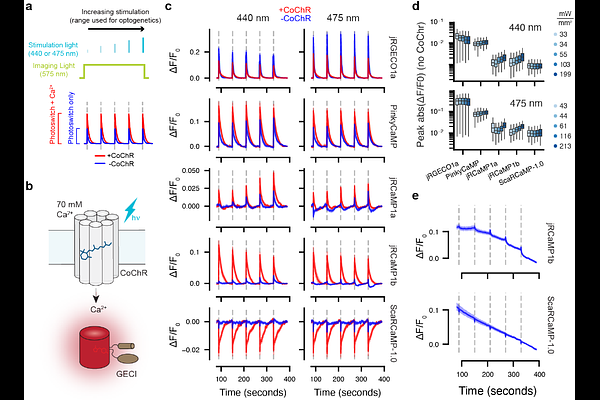
AbstractRed genetically encoded calcium indicators (GECIs) are important tools for live cell and in vivo imaging. However, their application in optogenetic experiments has been limited by their complex photophysics, which can yield blue-light-induced artifacts. These photophysical drawbacks arise from the fluorescent protein (FP) used to construct the GECI. To address these limitations, we engineered novel red GECIs based on photostable red FPs, including mScarlet variants. After testing multiple design topologies and screening for calcium responses, we identified a lead variant, named ScaRCaMP-1.0. ScaRCaMP-1.0 exhibits moderate Ca2+ responses ({Delta}F/F0 = -13%) relative to other red GECIs, a tradeoff that appears to have enabled remarkable blue-light photostability at power densities exceeding 200 mW/mm2. We validated the performance of ScaRCaMP-1.0 in an optogenetic regime, and in vivo via fiber photometry. Finally, guided by structural predictions, we investigated the mechanism underlying ScaRCaMP responses. A pair of lysine residues on the surface of the FP appear to be important for controlling Ca2+ responses, and mutation of one residue (K132Y) notably increased the response size ({Delta}F/F0 = -22%) without compromising blue-light photostability. We call the improved variant ScaRCaMP-2.0. Taken together, these results establish ScaRCaMP as an optogenetics-compatible red GECI and demonstrate the potential of mScarlet-based fluorophores as a basis for generating photostable red biosensors.