Brain morphological pattern is associated with the presence, severity, and transition of transdiagnostic psychiatric disorders in preadolescents

Brain morphological pattern is associated with the presence, severity, and transition of transdiagnostic psychiatric disorders in preadolescents
kuang, n.; Hammond, C. J.; Salmeron, B. J.; Xiao, X.; Wang, D.; Murray, L.; Gu, H.; Zhai, T.; Zheng, H.; Hill, J.; Scavinicky, M.; Lu, H.; Janes, A.; Ross, T. J.; Yang, Y.
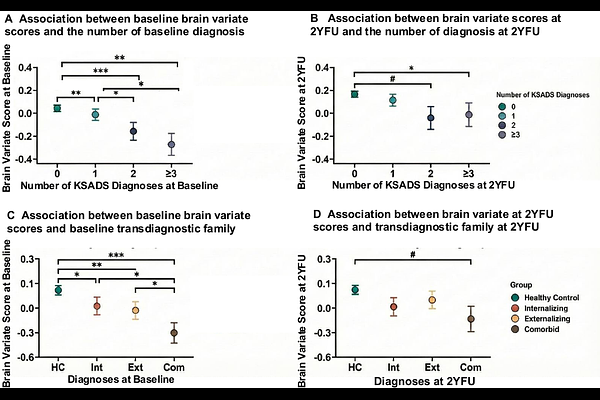
AbstractCognitive function, psychological processes, mental states, and behaviors are key dimensions of human subjective experience that separately relate to mental disorders across diagnostic categories. However, whether these dimensions are linked to common or distinct brain morphological patterns that convey risk or resilience for psychiatric disorders remains unclear. The current study is a longitudinal investigation on 11,875 youths from the Adolescent Brain Cognitive Development (ABCD) Study aged 9 to 10 years at baseline. A machine learning approach based on canonical correlation analysis was used to identify latent dimensional associations of cortical morphology (4 metrics: surface area, cortical and subcortical volume, cortical thickness, and sulcal/gyral depth) with multidomain behavioral assessments including cognitive scores and psychological measures indexing motivation, impulse control, mental states, and behaviors across a normative continuum from healthy to pathological. Across morphological measures, we identified a robust latent brain structural variate that correlated positively with cognitive performance and negatively with psychological measures indexing greater psychology. Notably, higher scores on this brain variate reflected larger cortical surface area and cortical volume especially in the temporal gyri together with a posterior-anterior gradient in cortical thickness, showing relatively greater thickness in occipital, parietal, and temporal cortices and lower thickness in cingulate and frontal regions. This brain variate and the related cognitive psychological and behavioral variate remained stable at the 2 year follow up, demonstrating temporal consistency. Importantly, the brain variate showed a dose-dependent relationship with the cumulative number of psychiatric diagnoses assessed concurrently and at 2 year follow up, with lower brain variate scores being associated with higher numbers of comorbid diagnoses. In addition, the brain scores were associated with longitudinal transitions between healthy and diagnosed states over the 2 year study period, in which lower scores at baseline were associated with persistent psychiatric diagnoses whereas higher scores at baseline were associated with persistent healthy states, suggesting that the brain scores capture a vulnerability resilience continuum for psychopathology. By revealing shared brain structural substrates across conventional diagnostic boundaries, these findings advance the neurodevelopmental understanding of psychiatric disorders and highlight the potential utility of morphology informed approaches for early screening and intervention in youth. Keywords: Adolescence; Cortical morphological measures; Cognitive function; Psychological processes; Transdiagnostic factor