Multiscale computational framework for generating vascularizedbiohybrid tissue constructs

Multiscale computational framework for generating vascularizedbiohybrid tissue constructs
Guy, A. A.; Justin, A. W.; Markaki, A. E.
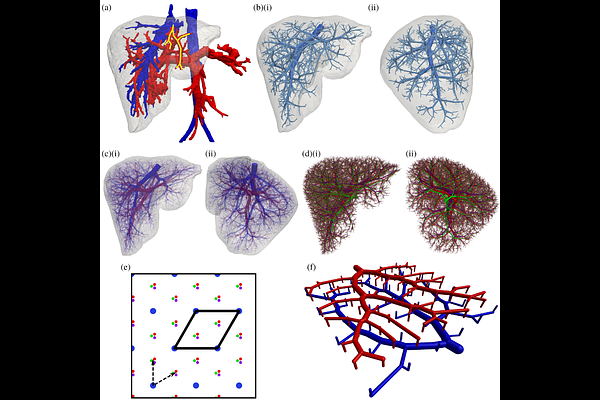
AbstractVascularization remains a central challenge in building large-scale biohybrid tissues that integrate living and synthetic components. Without a perfusable vascular network, nutrient delivery and waste removal become insufficient, leading to hypoxia and a loss of viability in thicker tissue constructs. We present Lattice Sequence Vascularization (LSV), a multiscale computational design framework for generating hierarchical, biomimetic vascular networks that are compatible with 3D-printing constraints and manufacturable within arbitrary geometries. LSV employs a divide-and-conquer strategy in which vessels grow and remodel at a specified terminal scale before recursively subdividing to form the full hierarchy. By enforcing hierarchy, LSV produces networks that exhibit self-similarity across length scales, a defining feature of physiological vasculature. The framework integrates synthetic considerations (e.g., hydrogel permeability), biological constraints (Murray's law, cross-scale biomimicry, organ-specific perfusion requirements) and manufacturing requirements relevant to 3D printing and microfabrication. We demonstrate the incorporation of capillary-scale functional substructures (e.g. organoid traps) and the generation of complex architectures with multiple inlets and outlets (e.g. liver-like geometries), enabling organ-scale vasculature design.