Raybloc: A Marine Bioactive Silica-Microsponge Formulation Confers Superior Protection against Blue Light and Infrared-A Induced Skin Damage in Murine Model

Raybloc: A Marine Bioactive Silica-Microsponge Formulation Confers Superior Protection against Blue Light and Infrared-A Induced Skin Damage in Murine Model
Yu, S.; Ngo, K.; Ovais, M.
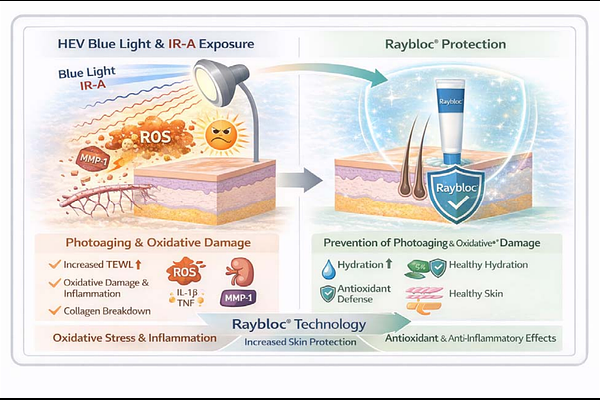
AbstractLong-term exposure to high-energy visible (HEV) blue light and infrared-A (IR-A) radiation accelerates oxidative stress, inflammation, and transepidermal water loss (TEWL), leading to photoaging and damage to the skin barrier. In this study, we developed Raybloc, a marine bioactive silica microsponge formulation, and evaluated its protective effects against combined high-energy visible (HEV; 410-480 nm) and infrared-A (IR-A; 700-1400 nm) exposure in a preclinical model. We divided 36 nude BALB/c-nu/nu mice into six groups: one that didn't get any treatment, one that got Raybloc (no radiation), one that got Raybloc 5%, one that got Raybloc 8%, one that got HA 0.5%, and one that got HA 0.8%. Animals underwent topical treatment for 14 days under regulated exposure to HEV (410-480 nm) and IR-A (700-1400 nm). We examined transepidermal water loss (TEWL), skin hydration, oxidative stress, inflammatory cytokines (IL-1 beta, IL-6, TNF-alpha, and IL-10), and histological indicators of collagen preservation through biophysical, biochemical, and histopathological techniques. In the Raybloc 8% group, TEWL dropped by 48.3 % (p < 0.001), and skin hydration went up by 62.7 %. The levels of ROS and MMP-1 expression decreased by 63.4% and 57.2%, respectively, while collagen I increased by 2.1 times compared to HA 0.8%. There was a big drop in the pro-inflammatory cytokines IL-1 beta, IL-6, and TNF-alpha, and a big rise in IL-10 (+38%). Histological analysis demonstrated well-preserved epidermal integrity and dense collagen bundles in Raybloc-treated mice, whereas irradiated controls exhibited dermal disorganization and inflammatory infiltration. Raybloc showed better photoprotective, antioxidant, and moisturizing effects than HA-based products. It also helped reduce oxidative and inflammatory skin damage caused by blue light and IR-A. These results support Raybloc as a next-generation multifunctional dermocosmetic that can help stop photoaging caused by digital and solar radiation.