Low-Frequency Recombination Lines from Galaxies and AGN over Cosmic Time

Low-Frequency Recombination Lines from Galaxies and AGN over Cosmic Time
Kimberly L. Emig, Sergei Balashev, Francoise Combes, Lucie Cros, Bjorn Emonts, Neeraj Gupta, Antoine Gusdorf, Emmanuel Momjian, Sébastien Muller, Elaine M. Sadler, Pedro Salas, Alexander G. G. M. Tielens, Ilsang Yoon
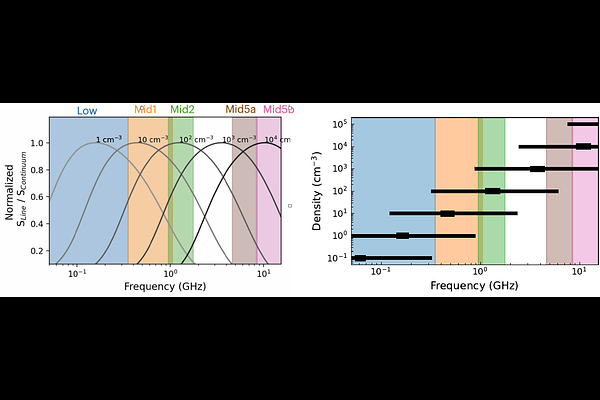
AbstractRadio recombination lines (RRLs) at low frequencies (<10 GHz) can provide a multi-phase view of interstellar gas in nearby galaxies, absorption-line-systems, and AGN. Hydrogen RRLs arise in fully ionized gas and carbon RRLs trace elusive cold-HI and CO-dark molecular gas. Low frequency RRLs are typically stimulated by the radio continuum and thus may be observable within or against radio bright sources out to cosmological distances (z ~ 6). Although long sought after, RRLs were only recently detected outside of the local universe (z ~ 1; Emig et al., 2020, 2023). Such detections have been made possible by the advancement of wide-bandwidth spectral-line surveys on next-generation low-frequency telescopes. Precursors and pathfinders to the SKA have opened up this field of research and will make significant advancements over the next years by enabling surveys over large source samples. The SKA will provide access to the crucial frequency ranges where RRL line intensity is brightest. Furthermore, multi-band SKA measurements will fully characterize gas physical conditions. Key extragalactic science of low frequency RRLs will focus on (i) the conversion of baryonic material into stars across cosmic time, (ii) the evolution of the ISM and its physical conditions in galaxies, and (iii) how gas drives and inhibits AGN activity.