Pretty Good Yields allow the spatial management of multiple objectives in agricultural landscapes

Pretty Good Yields allow the spatial management of multiple objectives in agricultural landscapes
Kubasch, M.; Costa, M.; Loeuille, N.
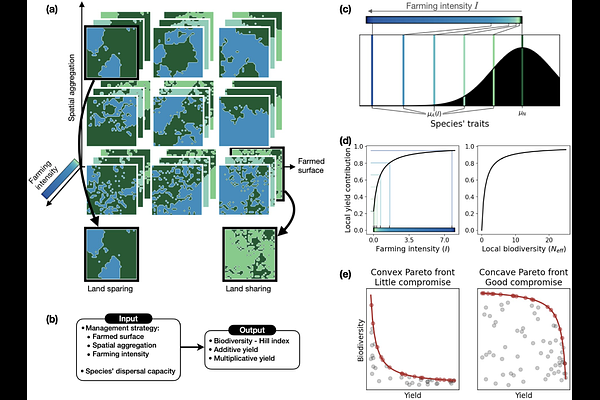
AbstractIn order to feed a growing global population without silencing nature, conceiving agricultural management strategies reconciling yield and conservation goals is key. Using numerical simulations of a metacommunity model, we explore the possibilities for compromise offered by spatial management strategies of farmed areas. Each strategy is characterized by its farming intensity, the proportion of farmed lands and their spatial aggregation. We show that achieving equitable yield-biodiversity compromise is difficult. While conciliatory strategies offering top yield and biodiversity are typically not possible, accepting slightly lower yields (ie, "Pretty Good Yield strategies") allows to recover substantial biodiversity. Such reconciliation possibilities are limited for species with small dispersal. Yield increases mainly through farmland expansion, whereas farming intensity strongly influences biodiversity, increasing it at low intensity before decreasing with further intensification. Finally, we demonstrate that reconciliation is easier if agricultural production relies on biodiversity through ecosystem services.