Closing the loop between brain and electrical stimulation: A proof-of-concept randomized trial of real-time fMRI-guided tACS optimization

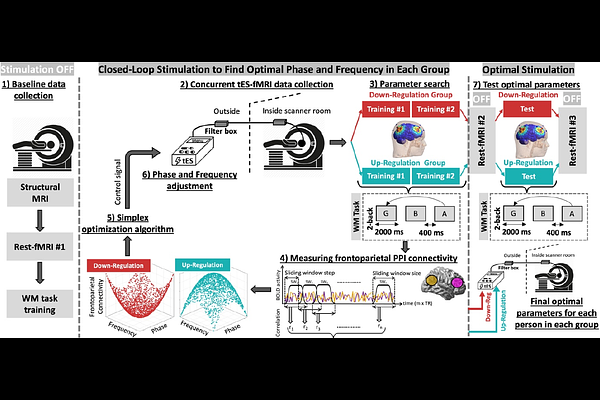
Closing the loop between brain and electrical stimulation: A proof-of-concept randomized trial of real-time fMRI-guided tACS optimization
Soleimani, G.; Kuplicki, R.; Mulyana, B.; Tsuchiyagaito, A.; Misaki, M.; Paulus, M. P.; Ekhtiari, H.
AbstractClosed-loop transcranial alternating current stimulation (tACS) combined with real-time functional MRI (tACS-fMRI) enables adaptive optimization of noninvasive brain stimulation based on ongoing neural dynamics. We implemented one of the first randomized, double-arm, closed-loop tACS-fMRI protocols to iteratively adjust stimulation frequency and phase alignment between the right dorsolateral prefrontal cortex (F4) and right inferior parietal cortex (P4) to modulate frontoparietal functional connectivity (FFC) during a 2-back working memory task. Twenty healthy adults were randomized to an up-regulation group (n = 10), receiving parameters optimized to maintain or enhance FFC, or a down-regulation group (n = 10), receiving parameters optimized to reduce FFC using a simplex-based adaptive algorithm across two training runs. Individualized optimized parameters were applied during a subsequent test run, with resting-state fMRI acquired before and after stimulation. During the test phase, connectivity trajectories diverged across groups: FFC was preserved in the up-regulation group but declined in the down-regulation group (signed-rank p = 0.019), with a significant between-group difference confirmed by permutation testing (20,000 iterations; p = 0.043). Behavioral effects were primarily observed in the accuracy learning dynamics. Although overall mean performance was comparable, the up-regulation group demonstrated a more positive accuracy trajectory, greater within-test accuracy gain (p = 0.036), and steeper trial-wise improvement (p = 0.035). Reaction time decreased across runs in both groups, consistent with practice effects, with no significant group differences in gain; however, the test-run RT slope showed a trend toward a steeper reduction in reaction time in the up-regulation group relative to the down-regulation group (p = 0.065). Resting-state analyses revealed significant time-by-group interaction clusters in seed-based connectivity (voxel-wise p < 0.001; cluster-level FDR p < 0.05), with connectivity increases observed in the up-regulation group relative to the down-regulation group, indicating persistent network modulation following stimulation. These findings demonstrate the feasibility of closed-loop tACS-fMRI for individualized network-targeted neuromodulation and suggest that real-time connectivity optimization selectively stabilizes task-relevant connectivity and enhances accuracy learning while producing sustained effects on intrinsic brain networks.