DELOS: Detecting Shallow Transits in Kepler Photometry Using a Contrastive-Learning Framework

DELOS: Detecting Shallow Transits in Kepler Photometry Using a Contrastive-Learning Framework
Qingtian Liu, Jian Ge, XingChen Yan, Kevin Willis, Xinyu Yao, QuanQuan Hu, Jiapeng Zhu
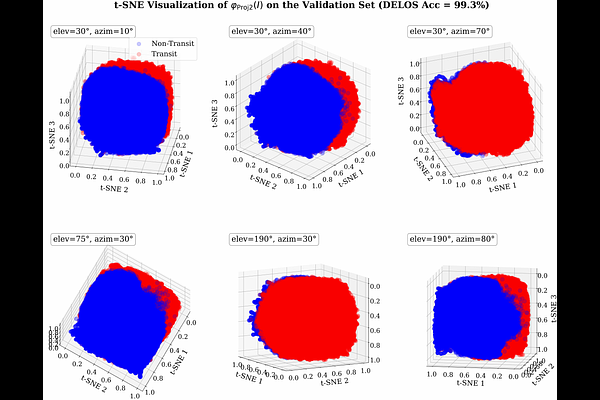
AbstractWe present DEtection in phase-folded Light curves with cOntrastive Scoring (DELOS), a contrastive-learning-based framework designed to search for shallow transits in Kepler photometry. DELOS combines GPU-accelerated phase folding, optimized phase binning, and a custom one-dimensional convolutional encoder to assign a transit-likeness score to each folded light curve, thereby producing a score periodogram over trial periods without relying on pre-detected threshold-crossing events. Focusing on intermediate-to-long-period signals with orbital periods of 100-150 days, DELOS was trained on 20 million synthetic light curves generated with realistic transit models and Kepler-like noise properties, achieving a validation accuracy of 99.3 percent on the synthetic validation set. In controlled injection-recovery experiments, DELOS improves the combined precision-recall performance by 15.5 percent relative to Box-fitting Least Squares (BLS) and 11.25 percent relative to Transit Least Squares (TLS) in the low Signal-to-Noise Ratios (low-SNR) regime. It also accelerates the search by factors of approximately 3-5 and 74-80 compared with BLS and TLS, respectively. Applied to a selected Kepler validation sample, DELOS recovered all known shallow intermediate-to-long-period transit signals in the tested period range. These results demonstrate that DELOS provides an efficient and sensitive framework for low-SNR transit searches and represents a practical step toward future searches for longer-period terrestrial planets in Kepler, K2, TESS, PLATO, and Earth 2.0 data. Accordingly, this work is intended as a methodological development and validation study, with the detailed astrophysical validation of newly identified candidates deferred to future work.