Metal Mayhem at $\rm z \sim 7-10$: Diversity and Evolution of Gas-Phase Metallicity Gradients

Metal Mayhem at $\rm z \sim 7-10$: Diversity and Evolution of Gas-Phase Metallicity Gradients
Maria Koller, Roberto Maiolino, Hannah Übler, Qiao Duan, Jan Scholtz, Santiago Arribas, William M. Baker, Stefano Carniani, Stephane Charlot, Mirko Curti, Luca Graziani, Gareth Jones, William McClymont, Michele Perna, Bruno Rodríguez Del Pino, Sandro Tacchella, Alessandra Venditti, Giacomo Venturi, Joris Witstok
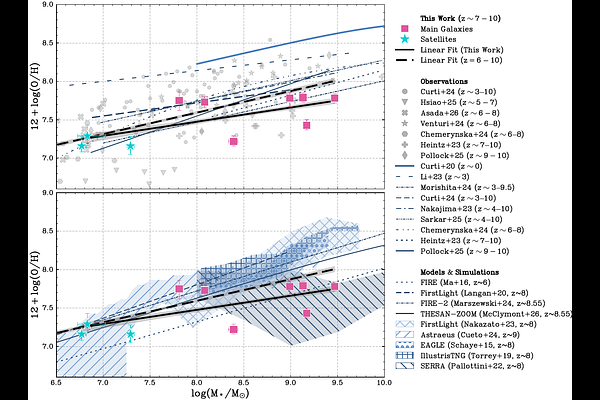
AbstractWe present a JWST/NIRSpec-IFU study of metallicity gradients in seven low-metallicity systems at $z=7.2-9.5$. The main sample spans stellar masses of $\rm \log(M_*/M_{\odot}) \sim 7.8-9.5$, star formation rates (SFRs) of $\rm \log(\text{SFR} / M_{\odot} \text{yr}^{-1}) \sim 0.5-2.5$, and gas-phase metallicities of $4\%-15 \%~Z_\odot$. Within our sample, we also identify three low-metallicity satellite galaxies associated with two of our sources, providing a rare view of early-epoch interactions. The three satellites exhibit even more primordial properties, with metallicity $3\% -4\% ~Z_\odot$ and low star-formation activity ($\rm \log(\text{SFR} / M_{\odot} \text{yr}^{-1}) \sim -0.5$ to $-0.9$). We find that our galaxies, and especially the satellites, are significantly offset from the local Fundamental Metallicity Relation (FMR), with deviations reaching $Δ\text{FMR} \approx -0.9$ dex. This indicates that these galaxies are likely experiencing strong accretion of pristine gas. Overall, we observe a large scatter in radial metallicity gradients, ranging from positive to negative with an average metallicity gradient of $\rm -0.02 \pm 0.04 \ dex \ kpc^{-1}$. Flat gradients are found in systems with confirmed satellites, suggesting that tidal interactions and mergers drive the radial mixing necessary to homogenise the interstellar medium. The (tentative) presence of an AGN in two of our sources suggests that strong feedback may also be responsible for the observed flat gradients. Conversely, the detection of a positive gradient in one source points toward a direct funnelling of metal-poor gas inflow into the central region of the galaxy. These results show that galaxies in the first billion years grow through diverse, episodic processes, suggesting that early evolution is characterised by structural variety rather than a single, predictable path.