Nutrient heterogeneity emerges from dynamical abiotic-biotic feedback in a spatially explicit plant-herbivore occupancy model

Nutrient heterogeneity emerges from dynamical abiotic-biotic feedback in a spatially explicit plant-herbivore occupancy model
Gounand, I.; Loeuille, N.; Charberet, S.; Fronhofer, E. A.; Harvey, E.; Kefi, S.; Leroux, S. L.; Little, C. J.; McLeod, A.; Saade, C.; Massol, F.
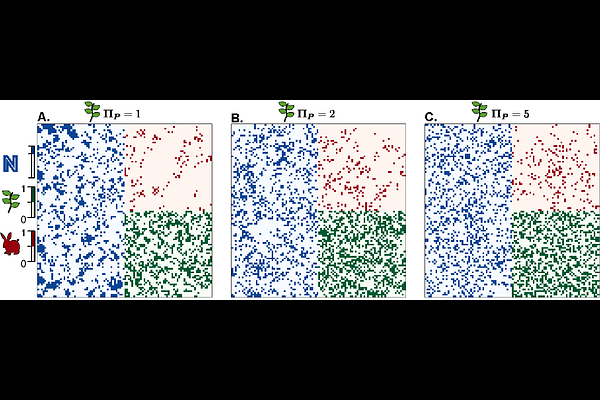
AbstractSpatial heterogeneity of abiotic resources is essential for species coexistence. Ecological theory often assumes predefined heterogeneity of resources that constrains community dynamics, but the recent developments of meta-ecosystem ecology and zoogeochemistry highlight nutrient patterns could result from the interactions between the activities and movements of organisms and their abiotic environment. Here we investigate the mechanisms by which biotic-abiotic feedbacks could generate nutrient spatial heterogeneity in a simple plant-herbivore occupancy model where populations forage, recycle, and disperse in a homogenous landscape. By systematically varying organisms' ranges of foraging and dispersal, and recycling levels, we found that limited dispersal of plants plays a key role on the emergence of nutrient patchiness by favoring small clusters of vegetation that shape their environment through consumption and recycling. However, herbivores could also create nutrient spatial heterogeneity when large foraging and dispersal ranges, and high recycling, allow them to efficiently track plant hot spots and to increase population persistence. Unexpectedly, strong aggregation of herbivore populations did not necessarily result in nutrient clustering. Rather than via recycling, herbivores mainly affected nutrient distribution indirectly, through their top-down impact on plant distribution. When evenly spread in the landscape, herbivore populations with large foraging ranges created areas of strong herbivory pressure unfavorable to plant colonization where nutrient can accumulate. These results can help understand the dynamical feedback between biota and abiotic resources. In a context where human activities alter both nutrient distribution and species abundances, a better understanding of this biotic-abiotic feedback will be key to anticipate the response of ecosystems to current perturbations.