Morphotype-Resolved 3D Morphometry Reveals a Structure-Density-Location Coupling in Mitochondrial Networks

Morphotype-Resolved 3D Morphometry Reveals a Structure-Density-Location Coupling in Mitochondrial Networks
Singh, A.; Yadav, A.; Deshmukh, A.; Singh, A.; Verma, R.; White, K. L.; Singla, J.
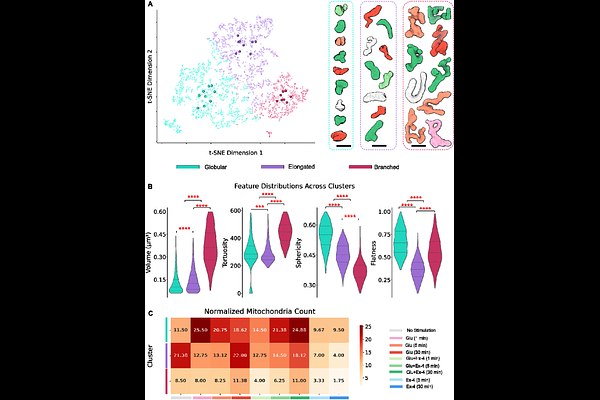
AbstractMitochondrial architecture plays a critical role in cellular function, yet how organelle structure, metabolic density, and subcellular position are jointly remodeled across whole cells remains poorly understood. We applied quantitative 3D soft X-ray tomography to analyze intact INS-1E cells in a native, cryo-hydrated state. By integrating morphometric profiling with voxel-level linear absorption coefficients (LAC) and contour-based radial mapping, we tracked the structural, biochemical, and spatial remodeling of fragmented, intermediate, and interconnected mitochondrial morphotypes under high glucose and Exendin-4 stimulation. High glucose induces morphotype-specific hypertrophy, fission, and perinuclear redistribution of low-density fragments. Co-stimulation with Exendin-4 stabilizes interconnected networks and increases metabolic density at the cell periphery. Morphotype-resolved analysis uncovers a structure-density-location coupling in which mitochondrial shape, macromolecular packing, and radial position shift in concert. These results offer a quantitative framework and high-resolution spatial constraints for whole-cell modeling of organelle dynamics.