Reference genomes of four miniature and non-miniature cypriniform fishes inhabiting acidic peat-swamp forest blackwaters of Southeast Asia

Reference genomes of four miniature and non-miniature cypriniform fishes inhabiting acidic peat-swamp forest blackwaters of Southeast Asia
Sudasinghe, H.; Liu, Z.; Triginer-Llabres, L.; Hui Tan, H.; Britz, R.; Salzburger, W.; Peichel, C.; Rueber, L.
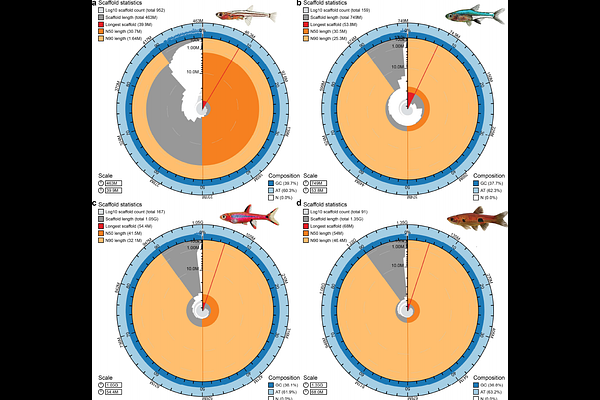
AbstractThe acidic blackwaters of Southeast Asia peat-swamp forests represent some of the most extreme freshwater environments on Earth. Despite their very low pH values, limited nutrients, and hypoxic conditions, these blackwater habitats harbor a remarkable diversity of freshwater fishes, including multiple lineages that have independently adapted to these extreme conditions and, in some cases, exhibiting extreme body miniaturization. These replicate evolutionary lineages therefore provide a powerful comparative framework to investigate adaptation to extreme environments and the genomic basis of miniaturization. Here, we present high-quality, annotated reference genomes for four cypriniform species endemic to these peat-swamp forest ecosystems: Paedocypris sp., Sundadanio atomus, Boraras brigittae, and Rasbora kalochroma. The first two are progenetic miniatures, including Paedocypris, comprising the smallest known fish, while B. brigittae represents a proportioned dwarf and R. kalochroma a non-miniature taxon. Genome sizes ranged from 401-1,290 Mb and heterozygosity from 0.34-1.7%. All genome assemblies achieved pseudo-chromosome-level contiguity, high k-mer completeness (>99%), and high BUSCO completeness (94.5-98.9%). Repeat analyses revealed lineage-specific differences in transposable element landscapes and abundances, while gene annotation identified notable intron length reduction in progenetic miniatures.