Position: Embodied AI Requires a Privacy-Utility Trade-off

Position: Embodied AI Requires a Privacy-Utility Trade-off
Xiaoliang Fan, Jiarui Chen, Zhuodong Liu, Ziqi Yang, Peixuan Xu, Ruimin Shen, Junhui Liu, Jianzhong Qi, Cheng Wang
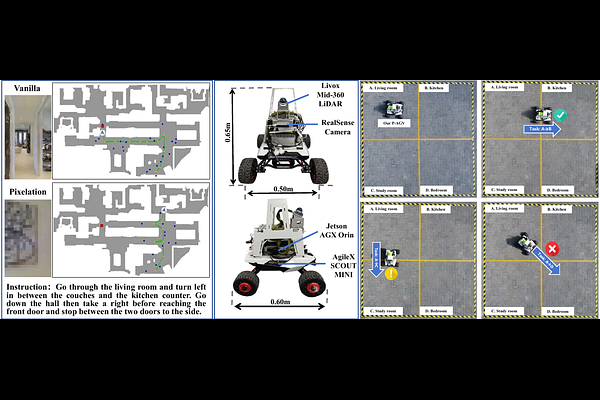
AbstractEmbodied AI (EAI) systems are rapidly transitioning from simulations into real-world domestic and other sensitive environments. However, recent EAI solutions have largely demonstrated advancements within isolated stages such as instruction, perception, planning and interaction, without considering their coupled privacy implications in high-frequency deployments where privacy leakage is often irreversible. This position paper argues that optimizing these components independently creates a systemic privacy crisis when deployed in sensitive settings, thereby advancing the position that privacy in EAI is a life cycle-level architectural constraint rather than a stage-local feature. To address these challenges, we propose Secure Privacy Integration in Next-generation Embodied AI (SPINE), a unified privacy-aware framework that treats privacy as a dynamic control signal governing cross-stage coupling throughout the entire EAI life cycle. SPINE decomposes the EAI pipeline into various stages and establishes a multi-criterion privacy classification matrix to orchestrate contextual sensitivity across stage boundaries. We conduct preliminary simulation and real-world case studies to conceptually validate how privacy constraints propagate downstream to reshape system behavior, illustrating the insufficiency of fragmented privacy patches and motivating future research directions into secure yet functional embodied AI systems. We detail the SPINE framework and case studies at https://github.com/rminshen03/EAI_Privacy_Position.