Spectral and non-spectral EEG measures in the prediction of working memory task performance and psychopathology

Spectral and non-spectral EEG measures in the prediction of working memory task performance and psychopathology
Peck, F. C.; Walsh, C. R.; Truong, H.; Pochon, J.-B.; Enriquez, K.; Bearden, C. E.; Loo, S.; Bilder, R.; Lenartowicz, A.; Rissman, J.
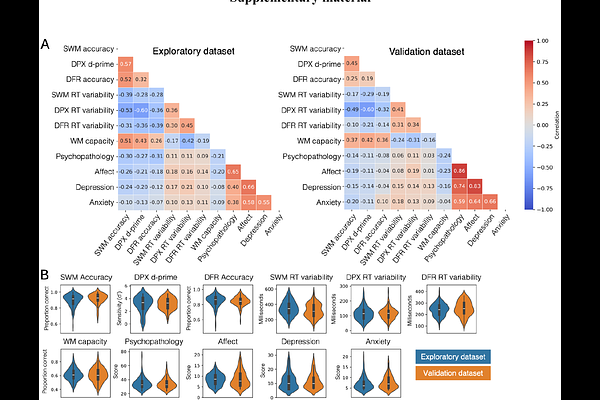
AbstractWorking memory (WM) supports the temporary maintenance of goal-relevant information and is disrupted across many neuropsychiatric disorders. We examined whether scalp electroencephalography (EEG) data features beyond spectral power, including waveform shape, broadband spectral structure, and signal complexity, provide complementary information for predicting cognitive and clinical outcomes. EEG was recorded from 200 adults spanning a broad range of neuropsychiatric symptom severity while they completed three WM task paradigms: Sternberg spatial WM (SWM), delayed face recognition (DFR), and dot pattern expectancy (DPX). Separate machine learning models were trained on EEG features from the encoding, delay, and probe phase of each task to predict participants' task accuracy, reaction time (RT) variability, WM capacity, and psychopathology scores (Brief Psychiatric Rating Scale). A split-half analytic framework was used, with cross-validated model development in an exploratory dataset (N=100) and evaluation of statistically significant models in a held-out validation dataset (N=100). In the exploratory dataset, SWM task data best predicted WM capacity, DPX task data predicted RT variability, and DFR task data predicted psychopathology, suggesting that these three WM paradigms engage distinct neural processes relevant to different outcomes. No models reliably predicted task accuracy. Models incorporating features beyond spectral power generally outperformed power-only models, and task-derived features outperformed resting-state-derived features. However, only those models predicting WM capacity and RT variability generalized to the validation dataset; models predicting psychopathology did not. These findings demonstrate functional heterogeneity across WM paradigms, show that complementary EEG features enhance predictive modeling, and highlight the importance of rigorous validation for identifying robust brain-behavior relationships.