Core-envelope coupling of gravito-inertial waves in pre-main-sequence solar-type stars

Core-envelope coupling of gravito-inertial waves in pre-main-sequence solar-type stars
Sylvain N. Breton, Camilla Pezzotti, Stéphane Mathis, Lisa Bugnet, Maria Pia Di Mauro, Johannes Joergensen, Konstanze Zwintz, Antonino F. Lanza
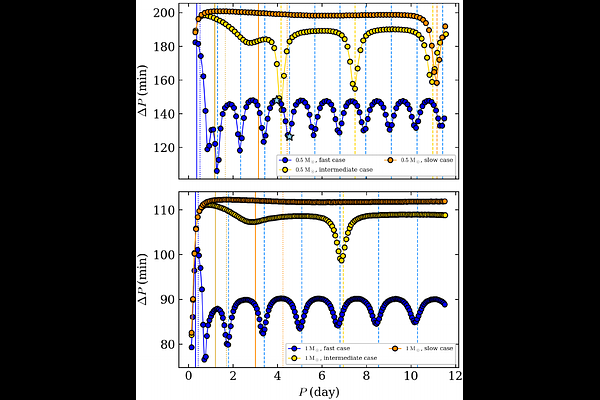
AbstractAfter the recent detection of solar equatorial Rossby waves, a renewed interest has been brought to the study of gravito-inertial waves propagating in the convective envelope of solar-type stars. In particular, the ability that some of these envelope gravito-inertial modes have to couple with the ones trapped in the radiative interior might open new windows to probe the deep-layer dynamics of solar-type stars. The possibility for such a coupling to occur is particularly favoured in pre-main sequence (PMS) solar-type stars. Indeed, due to the contraction of the protostellar object, they are able to reach large rotation frequencies before nuclear reactions are ignited and magnetic braking becomes the driving mechanism for their rotational evolution. In this work, we therefore study the coupling between the envelope inertial waves and the radiative interior g modes in PMS stars, focusing on the case of prograde dipolar modes. We consider the case of 0.5 Msun and 1 Msun PMS models, each with three different scenarios of rotational evolution. We show that, for stars that have formed with a sufficient amount of angular momentum, this coupling can occur in frequency ranges that are accessible to space-borne photometry, creating inertial dips in the period spacing pattern. With an asymptotic analysis we characterise the shape of these inertial dips to show that they depend on rotation and on the stiffness of the convective-radiative interface.