On the origin of the BAOtr-DESI tension

On the origin of the BAOtr-DESI tension
Ioannis Pantos, Leandros Perivolaropoulos
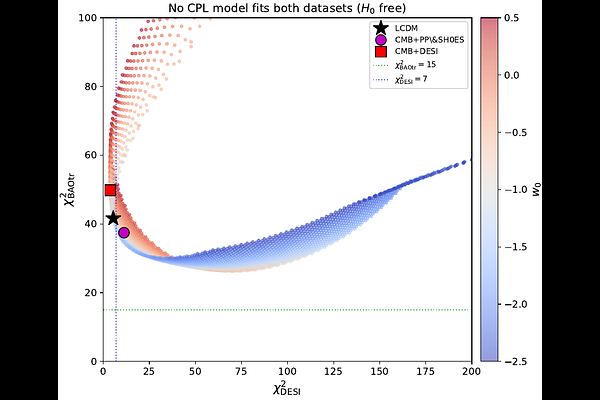
AbstractThe fiducial-independent transversal BAO dataset (BAOtr) systematically prefers smaller comoving distance ratios $D_{\rm M}/r_{\rm d}$ than the DESI DR2 three-dimensional BAO measurements at $z \lesssim 0.65$, driving dataset-dependent CPL dark-energy inferences and conflicting conclusions about the Hubble tension. We investigate whether this disagreement can be attributed to the $Λ$CDM fiducial assumed in the 3D BAO pipeline, or resolved within the CPL parametrisation. We show that the published 3D BAO distances are fiducial-independent by construction, with residual effects at $\lesssim 0.3\%$ -- negligible against the 10--18\% BAOtr uncertainties. We then scan the CPL parameter space with $Ω_m$ and $H_0$ jointly determined at each $(w_0, w_a)$ by the Planck $θ_*$ constraint and optimisation against the DESI data. Two complementary tests are performed: a direct comparison of each DESI-optimized model with the BAOtr data, and an $α$-interpolation test that anchors the prediction to the DESI measurements. Both reveal an inescapable trade-off: models that fit DESI well ($χ^2_{\rm DESI} \lesssim 5$) yield $χ^2_{\rm BAOtr} \gtrsim 42$, while reducing the BAOtr tension to $χ^2_{\rm BAOtr} \sim 37$ requires $χ^2_{\rm DESI} \gtrsim 8$. No CMB-consistent CPL model fits both datasets simultaneously. The direct comparison at $z = 0.510$ -- where BAOtr and DESI disagree by $3.7σ$ (data-versus-data) -- sets an irreducible tension floor that no smooth modification of $D_{\rm M}(z)$ can remove. These conclusions are robust across analysis methods, extrapolation schemes, and substitution of SDSS for DESI. The remaining explanations are observational systematics -- most plausibly in the angular BAO measurements -- or new physics beyond CPL.