Tracing the source of carbon oxides on the large moons of Uranus

Tracing the source of carbon oxides on the large moons of Uranus
Richard J. Cartwright, Sasha Cryan, Rosario Brunetto, Apolline Leclef, Eric Quirico, Bryan J. Holler, William M. Grundy, Tom A. Nordheim, Ujjwal Raut, Matthew M. Hedman, Riley A. DeColibus, Chloe B. Beddingfield, Marc Neveu, Christopher R. Glein, Sara Faggi, Geronimo L. Villanueva, Noemi Pinilla-Alonso, Stephanie M. Menten
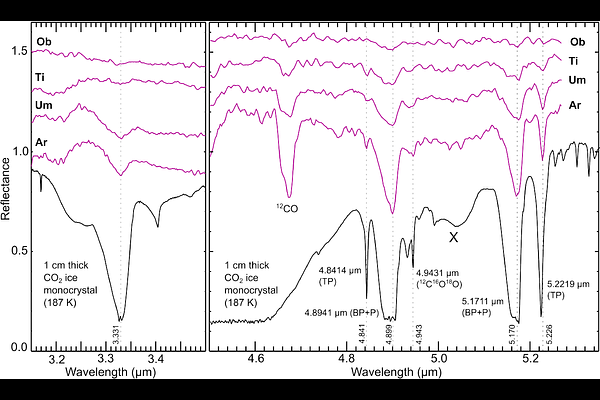
AbstractThe Uranian moons Ariel, Umbriel, Titania, and Oberon are enriched in CO2 mixed with CO, but the origin(s) of these carbon oxides, be they primarily native or radiolytic, remains uncertain. Using data collected by NIRSpec on the James Webb Space Telescope (JWST), we measured the spectral signature of CO2 and other carbon oxides to help disentangle these hypotheses. Through comparison to laboratory data, we find that many of the detected spectral features are consistent with CO2 ice, including 12CO2 scattering peaks (4.15 - 4.26 microns), multi-lobe 13CO2 bands (4.35 - 4.43 microns), and CO2 biphonon and triphonon modes (4.80 - 5.25 microns). Our measurements show that CO2 and CO are concentrated on the trailing hemispheres of the inner moons Ariel and Umbriel, potentially supporting a radiolytic production hypothesis, consistent with prior ground-based results. However, many of the identified spectral features are only observed in thick crystalline ice deposits measured in the laboratory, which may be difficult to form via radiolysis of carbon-bearing material mixed in icy regoliths. Similarly, the data exhibit weak 4.02 microns and 4.40 microns bands, hinting at the presence of carbonate minerals and 13CO2 clathrates, respectively, possibly formed in the interiors of these moons. Furthermore, JWST has revealed that CO2 is widespread at Uranus, present in its system of rings, ring moons, and irregular satellites, consistent with its largest moons accreting CO2 and other carbon oxides from the Uranian subnebula. We conclude that exposed carbon oxides are potentially native, with their surface distributions shaped by charged particle irradiation and seasonal sublimation-condensation cycles.