Genomic selection for seed yield enhances flax breeding efficiency

Genomic selection for seed yield enhances flax breeding efficiency
You, F. M.; Zheng, C.; Zagariah Daniel, J. J.; Li, P.; Jackle, K.; House, M.; Tar'an, B.; Cloutier, S.
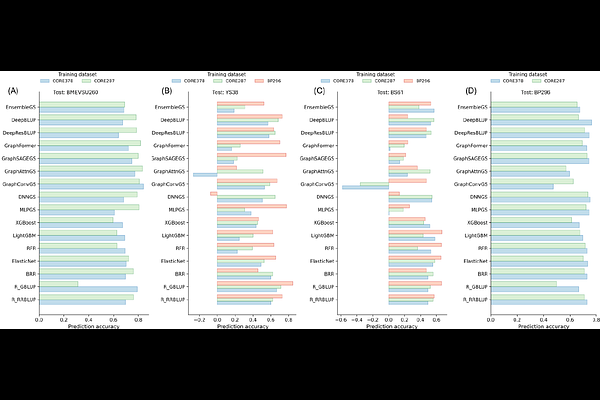
AbstractGenomic selection (GS) is a promising strategy to improve breeding efficiency for complex traits such as seed yield by enabling early selection and reducing reliance on extensive field testing. However, practical deployment of GS remains challenging due to limited training populations sizes and reduced prediction accuracies when models are applied to true breeding germplasm. In this study, we evaluated GS for flax (Linum usitatissimum L.) seed yield under realistic breeding scenarios, with a focus on across-population prediction (APP) and breeding decision support rather than model benchmarking. Using historical germplasm collections and a newly developed breeding-oriented population as training sets, GS performance was assessed across multiple independent test populations representing contemporary breeding lines evaluated in replicated yield trials. APP accuracies reached r = 0.84 when training and test populations were genetically aligned, supporting routine breeding deployment. Training population composition emerged as a key determinant of prediction success, with breeding-oriented populations consistently outperforming broad germplasm collections for predicting true breeding lines. Check-based selection analyses showed that GS reliably reproduced phenotypic advancement decisions while eliminating 61-91% of low-performing lines, resulting in 48-78% reduction in field evaluation costs for a typical cohort of 300 lines. Marker subsampling analyses further indicated that moderate-density genotyping-by-sequencing panels (~2,500-3,000 SNPs) are sufficient to achieve stable prediction accuracies. Overall, these results demonstrate that GS for seed yield in flax is ready for routine integration into breeding programs, offering a practical pathway to reduce costs, accelerate breeding cycles, and enhance selection efficiency.