A practical pipeline for volume rendering of trillion-voxel tomographic data

A practical pipeline for volume rendering of trillion-voxel tomographic data
Takeda, Y.; Obinata, D.; Harada, T.; Derin, M. O.; Ikegami, S.; Kubota, A.; Sasaki, S.; Fukai, R.; Usui, T.; Tainaka, K.; Iba, Y.
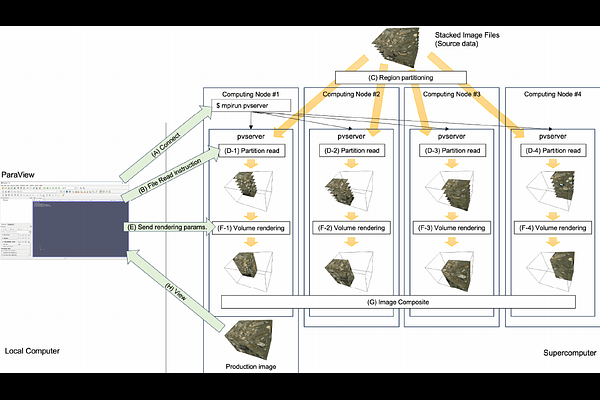
AbstractRecent advancements in tomography produce imaging data of geological materials (rocks and fossils) at trillion-voxel scales with multi-channels. Such high-resolution datasets are potentially keys to unveil evolutionary biological information with various shapes and sizes that have not been ever discovered. Volume rendering is an ideal visualization approach for them because it treats all voxels without relying on user-defined surface boundaries. However, these large-scale real-world tomographic data have rarely been volume-rendered at their native resolution, limiting the examination of rich morphological information. Here, we demonstrate a de facto standard volume-rendering pipeline running on a graphical processing unit (GPU)-equipped supercomputing system toward multi-channel, trillion-voxel tomographic data. Our workflow preserves original resolution, capturing detailed morphological information spanning microscopic to macroscopic scales. Systematic comparison of node types shows that GPU memory, rather than host memory, is the primary bottleneck. Our results establish a baseline for large-scale, multi-channel volume rendering of real tomographic data and demonstrate its applicability to geological samples. This work is presented as a practical demonstration of large-scale volume visualization.