Microlensing by Cluster of Primordial Black Holes

Microlensing by Cluster of Primordial Black Holes
K. A. Toshchenko, P. V. Baklanov, K. M. Belotsky, S. I. Blinnikov
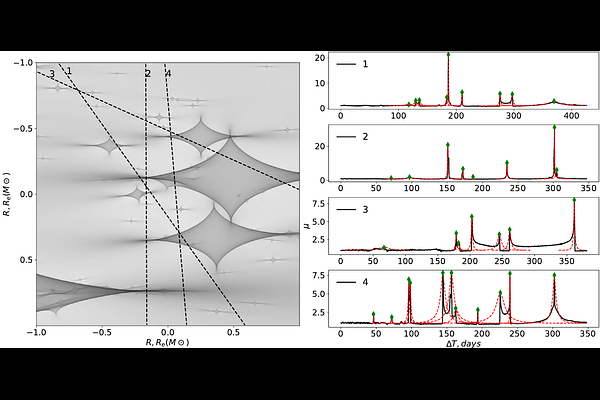
AbstractNumerous microlensing survey programs have constrained the possibility of dark matter existing in the form of compact objects within the Galactic halo. These constraints on the dark matter fraction were derived under the assumption of isolated, widely separated objects. This work investigates microlensing by primordial black holes (PBHs) organized into clusters. In this scenario, it is necessary to account for both the influence of neighboring PBHs and the collective gravitational potential of the entire cluster, which significantly complicates the microlensing light curve. Events exhibiting such complex light curves elude detection in observational experiments such as MACHO, EROS, OGLE, POINT-AGAPE, and HSC. It is demonstrated that a significant fraction of PBH dark matter (up to 93\% for the models studied) remains undetected in these observational data. However, for all considered cluster models, a substantial population of PBHs still behaves as isolated lenses. Consequently, the clustering of PBHs does not completely eliminate the microlensing constraints on the PBH contribution to dark matter.