Applying a metaweb approach to reserve design: large, well protected areas are crucial to maintain food webs

Applying a metaweb approach to reserve design: large, well protected areas are crucial to maintain food webs
Villain, T.; Erve-Sauvez, H.; Poggiale, J.-C.; Marsily, C.; Loeuille, N.
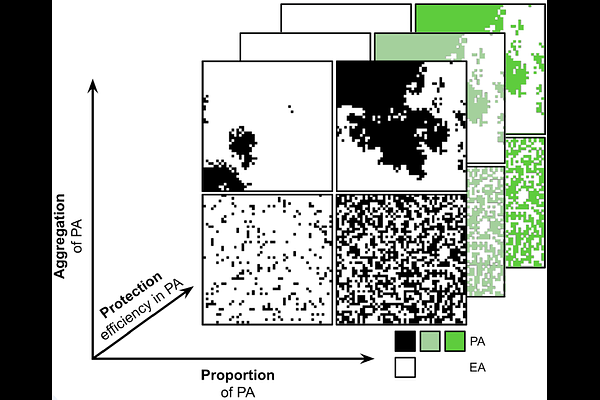
AbstractEstablishing protected areas is a promising tool to address the accelerating loss of biodiversity. However, protection levels are often low, and there is an ongoing debate over the most effective spatial configuration of reserves. This debate rarely considers trophic structure and ignores biodiversity outside protected areas. In this study, we investigate which reserve configurations best support species diversity and the persistence of high trophic levels, across systems and spatial scales, both inside and outside protected areas. Using a spatially explicit stochastic model, we assess how reserve architecture influences multiple conservation objectives across 27 empirical terrestrial, freshwater, and marine food webs. Specifically, we explore reserve architecture along three dimensions: the aggregation of protected areas, their proportion at the landscape scale, and the effectiveness level of protection measures. Our results show that having few but larger protected areas enhances all conservation metrics within reserves, while diversity within and outside reserves is relatively insensitive to reserve aggregation. Smaller and more dispersed reserves improve the overall abundance of species off-reserves through spillover effects. Reconciling all objectives inside and outside reserves becomes feasible when protection effectiveness is sufficiently high. Increasing the efficiency of protection allows for a reduction in the total amount of protected land without compromising conservation outcomes. Moreover, higher species dispersal facilitates the achievement of multiple conservation goals, supporting the implementation of architectures that enhance connectivity among reserves. These findings highlight the importance of an integrated approach combining spatial ecology and trophic functioning to optimize protected area planning under multiple objectives.