Hybrid virtual reality object lifting matches real-world object lifting

Hybrid virtual reality object lifting matches real-world object lifting
Sager, C. A.; Zenti, J.; Marneweck, M.
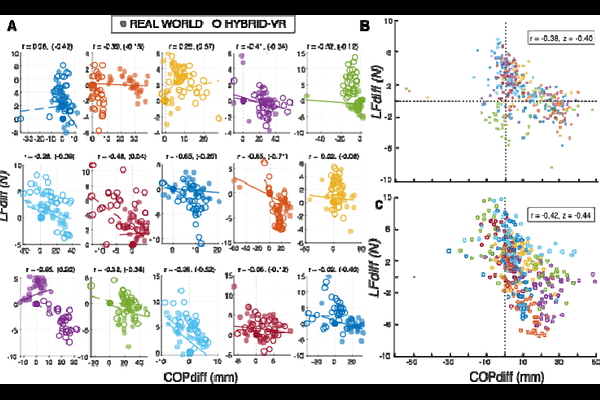
AbstractClinical deafferentation underscores the fundamental role of proprioception in motor control, but chronic sensory loss also drives long-term compensatory strategies that complicate mechanistic inference. Because proprioceptive reliability is difficult to manipulate experimentally, its contribution to skilled control remains unclear. Virtual reality (VR) with controlled visuo-proprioceptive offsets provides a promising model of proprioceptive unreliability that induces sensory reweighting toward vision during conflict. This VR-offset framework has advanced our understanding of vision-dominant control under proprioceptive unreliability in reaching tasks. It remains unknown how the motor system responds to proprioceptive unreliability during skilled object manipulation. Unlike reaching, manipulation requires anticipatory force/torque control that accounts for trial-to-trial variability in digit position; these policies are learned within a few trials, yet changes in object dynamics produce anterograde interference that increases with greater repetition before the dynamics switch. Although vision, tactile cues, and prior experience support these features, the role of proprioceptive reliability remains unresolved. Hybrid-VR, which pairs real object interaction with virtual visual feedback, offers a way to address this gap. Before introducing offsets, we must establish that hybrid-VR without offsets reproduces the hallmark behaviors highlighted above. Here, we compared real-world object manipulation with hybrid-VR object manipulation where participants (N = 15) lifted and stabilized an object with an asymmetric mass distribution. Across real-world and hybrid-VR conditions, the rate of anticipatory force control, trial-to-trial position-force adjustment, and switch-related interference were indistinguishable. These results demonstrate that hybrid-VR reproduces hallmark features of dexterous manipulation, providing a foundation for future studies isolating proprioceptive reliability.