Adventitious roots facilitate surface water uptake but only partially sustain transpiration under waterlogging in tomato (Solanum lycopersicum)

Adventitious roots facilitate surface water uptake but only partially sustain transpiration under waterlogging in tomato (Solanum lycopersicum)
PRODJINOTO, H.; Batat, D.; Nir, I.; Menkes, D.; Shenker, M.; Moshelion, M.
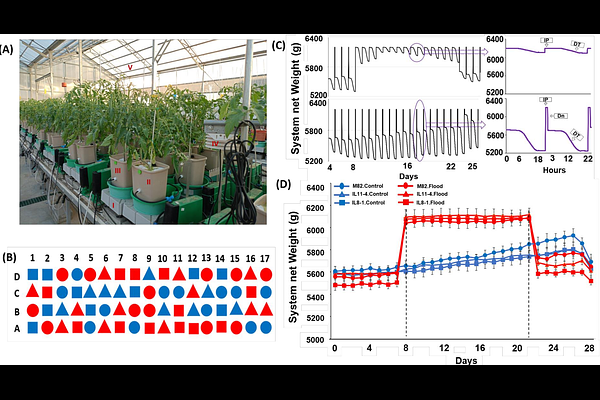
Abstractwaterlogging constrains terrestrial plants by limiting oxygen diffusion in the rhizosphere and altering root-zone physical and chemical properties. However, the extent to which whole-plant responses to waterlogging can be reproduced by oxygen deficiency alone remains unresolved. In tomato (Solanum lycopersicum), waterlogging is commonly associated with adventitious-root formation, yet the functional contribution of these roots to whole-plant water relations has rarely been quantified. Here, we experimentally separated root-zone hypoxia from waterlogging and quantified the contribution of surface-associated adventitious roots to whole-plant transpiration. Using high-resolution gravimetric lysimeters, we monitored transpiration dynamics under two conditions: (i) N2-driven displacement of root-zone O2 under near-field-capacity conditions and (ii) root-zone waterlogging. These measurements were complemented by analyses of soil redox potential and pH, mineral composition, stem anatomy, and genotypic variation among M82, IL11-4, and IL8-1. N2-driven oxygen depletion rapidly reduced rhizosphere O2 concentration and induced a moderate decline in redox potential, accompanied by changes in rhizosphere chemistry and mineral relations. Whole-plant transpiration, however, declined only progressively over several days. Under waterlogging, transpiration declined rapidly in all genotypes, with strong genotype dependence. A transient partial recovery coincided with the appearance of adventitious roots at the soil surface and was followed by renewed decline after drainage. Quantitative analysis indicated that adventitious roots contributed only a limited fraction of daily water uptake, approximately 15% to 20%, which was insufficient to restore pre-waterlogging transpiration or growth. Together, these results show that waterlogging responses were not reproduced by rapid oxygen deprivation alone and that adventitious roots provide limited hydraulic compensation.