Hippocampal BiP Overexpression Rescues Cognitive Performance and Increases REM theta in 3xTg Mouse Model of Alzheimer's Disease

Hippocampal BiP Overexpression Rescues Cognitive Performance and Increases REM theta in 3xTg Mouse Model of Alzheimer's Disease
Duncan, w.; Fenik, P.; Strus, E.; Veasey, S. C.; Naidoo, N.
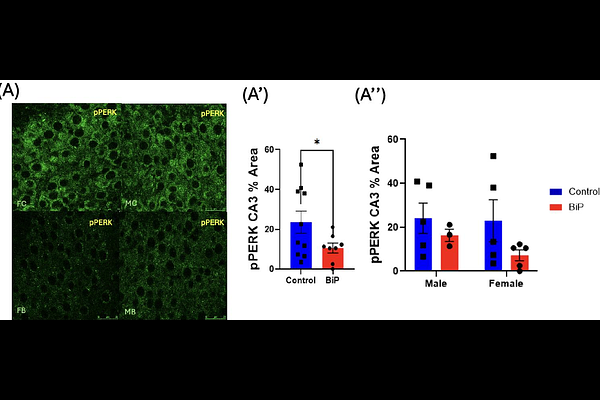
AbstractThe accumulation of A{beta} plaques and hyperphosphorylation of Tau neuropathologically characterize Alzheimer's disease (AD). Synaptic dysfunction and endoplasmic reticulum (ER) stress precede overt neuropathology. ER stress is characterized by the accumulation of unfolded/misfolded proteins, which leads to activation of the adaptive signaling pathway, the unfolded protein response (UPR). Chronic or unresolved ER stress, as in disease, is maladaptive and triggers the integrated stress response (ISR). We hypothesize that targeted attenuation of ISR activation would mitigate the early cognitive deficits and molecular pathology in the triple transgenic (3xTg) mouse model of AD. To test this hypothesis, we used an adeno-associated viral (AAV) vector to overexpress BiP, the key ER chaperone and UPR regulator, in the hippocampi of young 3xTg mice. BiP overexpression reduced phosphorylated PERK (pPERK), a marker of ISR activation, and increased synaptic proteins BDNF, PSD95, and choline acetyltransferase marker (ChAT). Hippocampal-dependent working memory, social memory, long-term spatial memory, and REM theta power were improved without changes in locomotion. BiP overexpression reduced neuroinflammation, as evidenced by a decrease in the astrocyte marker GFAP. Additionally, A{beta} and A{beta}42 levels were reduced in the hippocampus and cortex. Collectively, these findings indicate that modulation of ER stress via BiP overexpression ameliorates early cognitive and molecular alterations associated with AD.